| Quick Answer: There is no set Google Ads price in India. You pay per click, and the average cost per click ranges from roughly ₹7 to ₹150 for most industries, from as low as ₹3 in ecommerce to ₹400 or more in insurance and finance. A realistic starting budget is ₹200 to 500 per day, or ₹15,000 to 30,000 per month for a small business, with an 18% GST added on top of your ad spend. Your actual cost depends on your industry, keyword competition, city, and Quality Score. |
Google Ads costs in India range from about ₹7 to ₹150 per click for most industries, with competitive sectors like insurance and legal running far higher, and there is no fixed price because Google Ads runs on a live auction. Most Indian businesses spend between ₹15,000 and ₹1,00,000 per month depending on their industry, city, and goals. This guide gives you the real numbers: Google Ads cost in India CPC by industry in rupees, price per day and per month, cost per 1,000 impressions, and how to work out what you should actually budget. It also clears up the Google ad charges in India that catch people out, like the 18% GST on top of your spend.
Why Does Google Ads Have No Fixed Price in India?
Google Ads has no fixed price because it runs on a real-time auction, not a rate card. Every time someone searches, Google runs an instant auction among all advertisers bidding on that term and decides which ads show, in what order, and what each one pays. You set a maximum bid, but you almost never pay it in full. You pay just enough to beat the advertiser ranked below you.
Three forces set the price of a click in your category:
- Keyword demand. The more advertisers competing for a search term, the higher the auction clears. High-intent terms like “term insurance” or “personal loan” attract deep-pocketed bidders, so the price climbs.
- Customer value. Advertisers only sustain a high CPC if the customer is worth it. An insurer earning ₹40,000 from one policy can happily pay ₹400 a click; a retailer earning ₹300 of margin cannot. CPC tracks customer lifetime value more than anything else.
- Your Quality Score. Google multiplies your bid by a relevance score, so two advertisers bidding the same can pay very different prices. This is the one force you control directly.
This is why a furniture retailer can buy clicks for ₹15 while an insurance broker on the same platform pays ₹400. Same Google, same country, same month. The gap is the market pricing the value of a customer in each industry.
Google Ads Cost in India CPC by Industry (in Rupees)
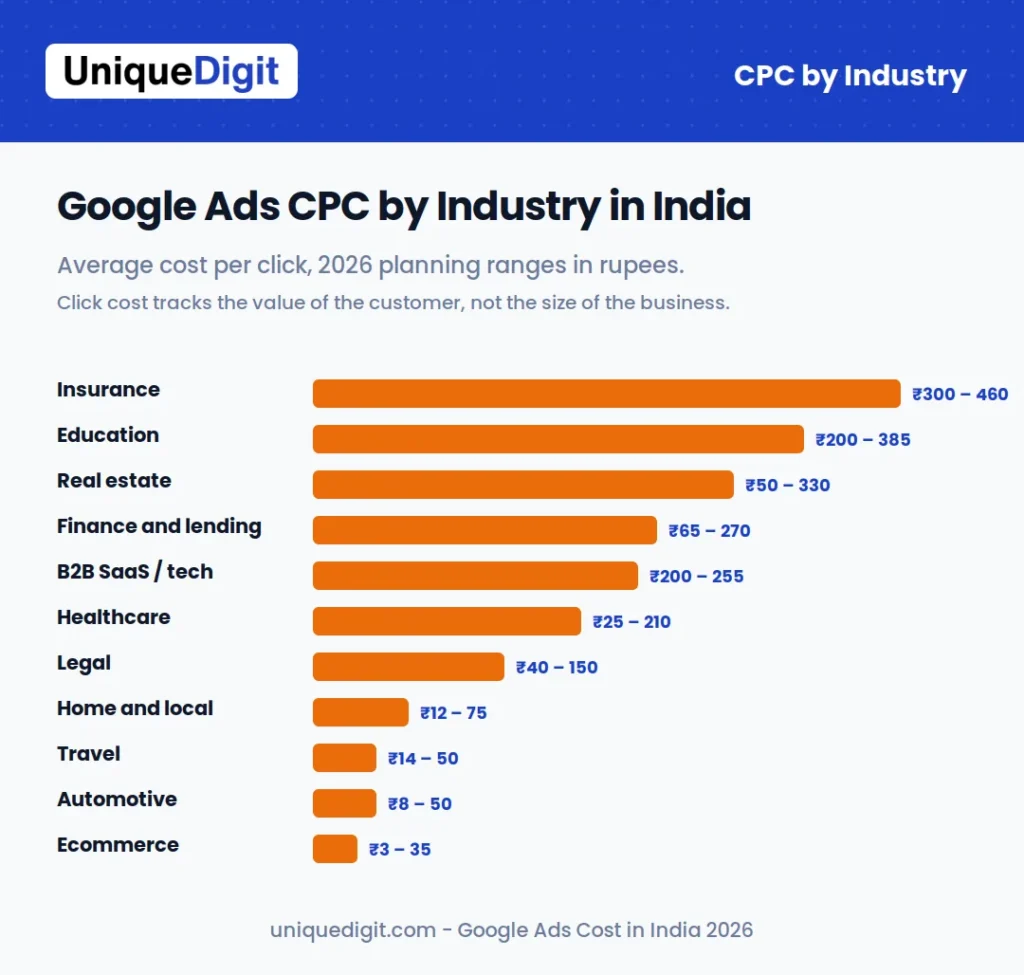
Google Ads cost in India by industry ranges from around ₹3 to ₹20 per click in ecommerce to ₹300 to ₹460 in insurance, with most service businesses sitting between ₹25 and ₹250. The table below shows indicative 2026 CPC ranges for broad commercial keywords targeting India. Treat these as planning ranges, not quotes, since your own CPC lands inside the range based on keyword intent, city, competition, and Quality Score.
| Industry |
Average CPC (₹) |
Why it sits here |
| Insurance (health, term, car) |
₹300 – 460 |
Highest customer value, many funded bidders |
| Education (MBA, study abroad) |
₹200 – 385 |
High course fees, long decision cycle |
| Real estate |
₹50 – 330 |
Large deal value, hyperlocal competition |
| Finance and lending |
₹65 – 270 |
High value, regulated, heavy competition |
| B2B SaaS and tech |
₹200 – 255 |
High contract value, global advertisers |
| Healthcare and medical |
₹25 – 210 |
High-ticket procedures, local intent |
| Legal services |
₹40 – 150 |
High case value, lower search volume |
| Home and local services |
₹12 – 75 |
Moderate ticket, high volume |
| Travel and tourism |
₹14 – 50 |
Thin margins, OTA-dominated |
| Automotive |
₹8 – 50 |
High volume, lower per-click intent |
| Ecommerce and retail |
₹3 – 35 |
Low margin, Shopping-driven, high volume |
The pattern is clear: click cost tracks the value of the customer, not the size of the business. A two-person insurance brokerage faces the same expensive clicks as a national insurer, because the auction prices the keyword, not the advertiser. Worth knowing too: Indian CPCs are often 70 to 80 percent lower than the global average, which makes Google Ads unusually accessible here.
How Much Do Google Ads Cost Per Day and Per Month in India?
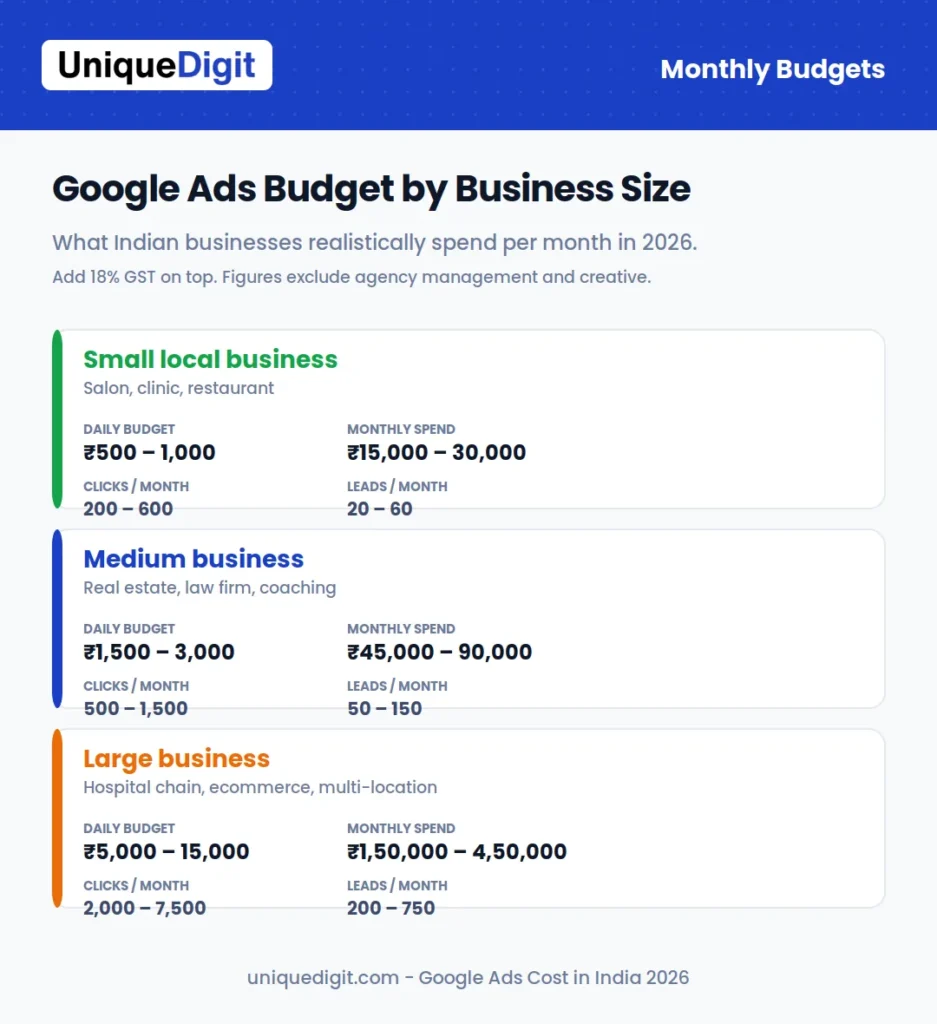
Google Ads price in India starts at around ₹200 to 500 per day, or ₹15,000 to 30,000 per month for a small business, though competitive categories need far more. There is no minimum spend required, but spreading too little over a month never gathers enough data to optimise. Here is a realistic view of Google Ads price per month in India by business size:
| Business type |
Daily budget |
Monthly spend |
Expected clicks |
Expected leads |
| Small local business (salon, clinic, restaurant) |
₹500 – 1,000 |
₹15,000 – 30,000 |
200 – 600 |
20 – 60 |
| Medium business (real estate, law firm, coaching) |
₹1,500 – 3,000 |
₹45,000 – 90,000 |
500 – 1,500 |
50 – 150 |
| Large business (hospital chain, ecommerce, multi-location) |
₹5,000 – 15,000 |
₹1,50,000 – 4,50,000 |
2,000 – 7,500 |
200 – 750 |
A simple way to set a daily budget is to multiply your expected CPC by the clicks you want. If your average CPC is ₹50 and you want 100 clicks a day, your daily budget is around ₹5,000. Two rules save more money than any bidding trick:
- Concentrate, do not spread. A budget split across five cities and forty keywords gives every campaign too little data to optimise. The same budget aimed at one city and a tight keyword set compounds.
- Plan for a learning period. The first 30 to 60 days are tuition. Costs start high and the algorithm is calibrating, so budgets pulled in week three never reach the efficiency that arrives in month two or three.
What Is the Google Ads Cost Per 1,000 Impressions in India?
The Google Ads cost per 1,000 impressions in India, known as CPM, averages around ₹50 for Display ads, making display one of the most economical formats for reach and awareness. Based on that average, display costs work out roughly as follows:
- 10,000 impressions: about ₹500
- 50,000 impressions: about ₹2,500
- 1,00,000 impressions: about ₹5,000
Display ads carry a much lower cost per click too, often around ₹5, because they have broader targeting and are built for awareness rather than immediate intent. The actual CPM for any campaign varies with your targeting and audience, so treat these as averages. If your goal is reach and brand recall rather than direct clicks, CPM-based Display is where your rupee stretches furthest.
How Much Do Google Sponsored Ads Cost in India by Format?
Google sponsored ads cost in India varies by format: Search ads run about ₹20 to 150 per click, Display around ₹5, Shopping about ₹24 per click, and Performance Max is priced on target cost per action rather than fixed clicks. Each format suits a different goal:
- Search ads. The classic sponsored results at the top of Google. Typical CPC of ₹20 to 150, with a 3 to 7 percent click-through rate. Best for capturing high-intent demand the moment someone searches.
- Display ads. Banner ads across Google’s partner sites. Very cheap at around ₹5 per click and ₹50 per 1,000 impressions. Best for awareness and retargeting.
- Shopping ads. Product listings with image and price. Average CPC around ₹24, and usually a strong return on ad spend for ecommerce.
- Performance Max. Google’s AI-driven format that bids across YouTube, Display, Search, Discover, Gmail, and Maps from one campaign. Priced on target cost per action or return on ad spend, so costs move with your conversion data. During peak seasons like Diwali, cost per acquisition can spike 30 to 50 percent as retail giants bid aggressively.
If you are weighing paid search against other channels entirely, our guide on SEO vs Google Ads for Indian businesses breaks down the trade-off.
Is Google Ads CPC or CPM? Understanding CPC vs CPM vs CPA
Google Ads can be CPC, CPM, or CPA depending on your campaign and bidding choice: Search ads are usually charged per click (CPC), Display and awareness campaigns can be charged per thousand impressions (CPM), and conversion campaigns are measured on cost per acquisition (CPA). They are not competing systems; they are three different ways of pricing and measuring the same spend.
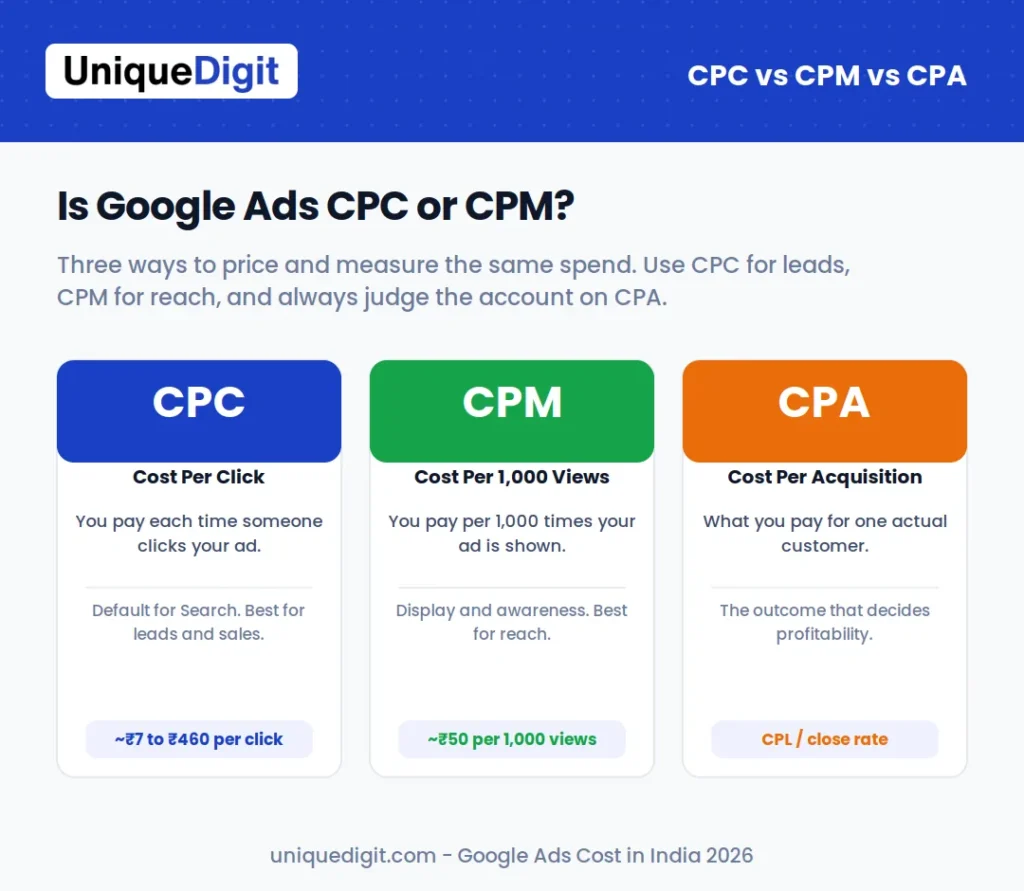
- CPC (cost per click). You pay only when someone clicks your ad. This is the default for Search campaigns and the model most people mean by “Google Ads cost.” It suits lead generation and sales, where a click is a real prospect.
- CPM (cost per thousand impressions). You pay per 1,000 times your ad is shown, regardless of clicks. This suits Display and video awareness campaigns where reach and brand recall matter more than an immediate click. In India, CPM on Display averages around ₹50.
- CPA (cost per acquisition). Not a bidding input but the outcome that matters most. It is what you pay for one actual customer, and it equals your cost per lead divided by your lead-to-customer close rate.
The practical way to think about it: use CPC campaigns when you want clicks and leads, CPM campaigns when you want visibility, and always judge the whole account on CPA, because that is the number that tells you whether Google Ads is profitable. A low CPC that never converts is worse than a high CPC that produces cheap customers.
How Do You Calculate Your Google Ads Budget?
You calculate your Google Ads budget by working backward from a customer: decide how many conversions you need, estimate the clicks required at your industry CPC, and multiply out to a monthly and daily figure. This five-step method turns budgeting from a guess into a plan.
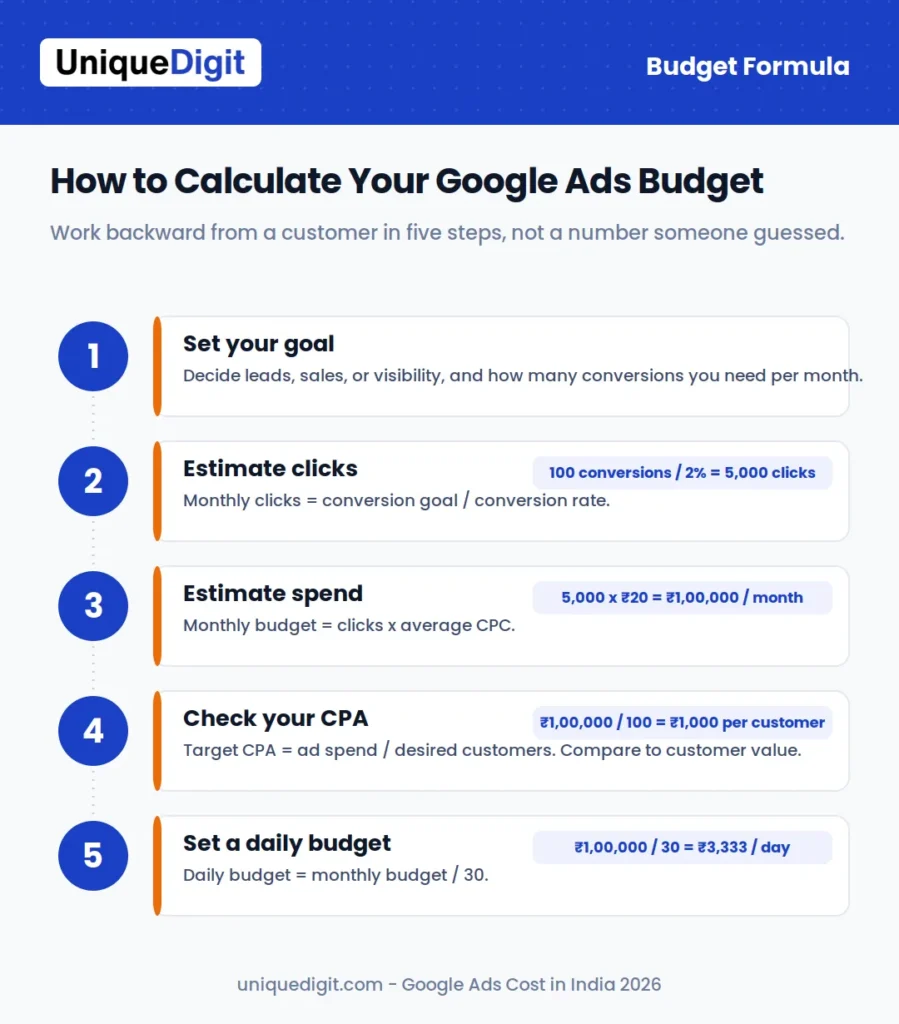
- Set your goal. Decide whether you want leads, sales, or visibility, and how many conversions you need per month.
- Estimate click volume. Monthly clicks needed = monthly conversion goal ÷ website conversion rate. For example, 100 conversions at a 2 percent conversion rate needs 5,000 clicks.
- Estimate monthly spend. Monthly budget = monthly clicks × average CPC. At 5,000 clicks and a ₹20 average CPC, that is ₹1,00,000 a month in media.
- Check cost per acquisition. Target CPA = total ad spend ÷ desired customers. Compare it to your customer value; if the CPA is lower than what a customer is worth, the budget works.
- Set a daily budget. Daily budget = monthly budget ÷ 30. So ₹1,00,000 a month is roughly ₹3,333 a day.
Treat these as a starting point, then refine with real campaign data once your ads are live. A worked example makes the maths concrete: at a ₹50 average CPC and a 4 percent conversion rate, a ₹30,000 monthly media budget buys around 600 clicks, which produces about 24 leads. If 60 percent are qualified and you close 25 percent, that is roughly 3 to 4 customers a month, at a media cost per customer near ₹8,570 before GST and management.
How Does Google Actually Decide What You Pay Per Click?
Google decides your actual cost per click through Ad Rank, which combines your maximum bid with your Quality Score, so you usually pay less than your maximum bid. Your maximum CPC is a ceiling, not a price. Google charges the minimum needed to clear the Ad Rank threshold and beat the advertiser ranked below you.
The formula you will see everywhere is a useful teaching aid:
- Ad Rank = Maximum CPC × Quality Score. Google multiplies your bid by a relevance score from 1 to 10, so two advertisers bidding the same amount can pay very different prices.
- The practical effect. Move a keyword’s Quality Score from 4 to 8 and its real CPC can drop 30 to 40 percent at the same position, with no change to your bid. This is the single biggest cost lever on the platform.
- The nuance. The live auction evaluates expected click-through rate, ad relevance, and landing-page experience in real time for each query. The visible 1 to 10 score is a diagnostic scoreboard, not the live number, so time spent on your search-terms report often beats time spent chasing the displayed score.
How Does Your Daily Budget Really Work in Google Ads?
Your Google Ads daily budget sets an average, not a hard cap, and Google can spend up to twice your daily budget on a high-opportunity day while keeping the monthly total in check. Two rules from Google’s budget documentation catch people out:
- The monthly limit is your daily budget × 30.4. A ₹500 daily budget allows roughly ₹15,200 a month; ₹1,000 a day allows about ₹30,400; ₹2,000 a day about ₹60,800.
- A single day can spend up to 2× the daily budget. When Google sees stronger traffic or conversion opportunity, it can spend up to twice your daily budget on that day, then balance it across the month so you never exceed the monthly limit.
So a ₹1,000 daily budget producing a ₹1,900 day is the system working as designed, not a billing fault. One caution: changing budgets mid-month recalculates these limits, so constant fiddling makes spend genuinely unpredictable. Set a budget and give it room to run.
Why Is CPC Not the Cost That Actually Matters?
CPC is not the cost that decides profitability; cost per lead is, and it equals your cost per click divided by your landing-page conversion rate. Founders often compare CPCs and conclude their industry is too expensive, but the click is not what you are buying. You are buying customers, and a click only becomes a customer after it survives your landing page.
Run the same CPC through two conversion rates and the economics flip:
- A ₹100 click at a 2 percent conversion rate needs 50 clicks per lead, so the lead costs ₹5,000.
- The same ₹100 click at a 5 percent conversion rate needs only 20 clicks, so the lead costs ₹2,000.
Same click, less than half the cost per lead, bought entirely on the strength of the landing page. This is the most underused insight in Indian PPC. Founders shave ₹10 off a CPC while ignoring a page that converts at 1.5 percent when it could convert at 4 percent. If your campaigns pull clicks but not enquiries, the problem is almost never the bid; it is the page the click lands on. A fast, focused site fixes this, which is where our web design and development work pays for itself.
What Are the Four Costs Inside a Google Ads Budget?
A Google Ads budget contains four separate costs that most quotes blend into one number: media spend, the 18% GST, management fees, and everything outside the ad account. Separating them is the single most useful thing you can do before committing a rupee, because folding them together is how businesses underfund the media and then conclude Google Ads does not work.
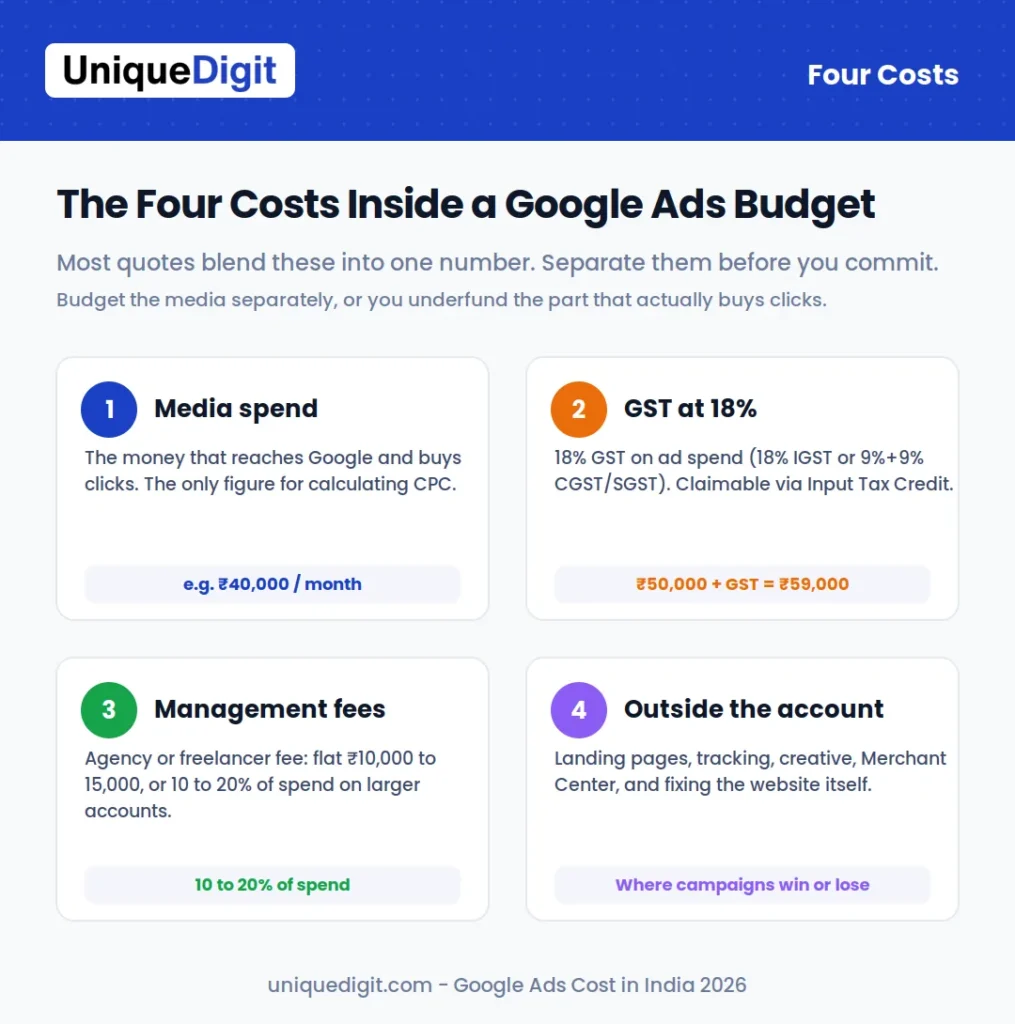
- 1. Media spend. The money that actually reaches Google and buys clicks. This is the only figure you should use to calculate CPC or media cost per lead. If your account spends ₹40,000 in a month, that is your media spend.
- 2. GST at 18%. Google Ads in India carries an 18 percent GST on your spend, appearing as either 18% IGST or 9% CGST plus 9% SGST depending on where you and Google India are registered. On ₹50,000 of media, that is ₹9,000, for a ₹59,000 cash outlay. GST-registered businesses may claim Input Tax Credit to offset it. One outdated figure still circulates: the 2% Regulatory Operating Cost, which Google stopped applying to ads served in India from September 2024. If a proposal still includes it, that proposal is stale.
- 3. Management fees. If an agency or freelancer runs the account, expect a flat monthly fee or a percentage of spend. Indian agency pricing in 2026 runs roughly ₹10,000 to 15,000 a month for accounts under ₹50,000 spend, and 10 to 20 percent of spend on larger accounts, with the percentage falling as spend rises. Watch for a fee quoted only as a share of spend with no floor, since it gives the agency a quiet incentive to recommend a bigger budget.
- 4. Everything outside the ad account. The costs that quietly sink campaigns: landing page design, conversion tracking setup, Google Tag Manager, call tracking, ad creative, Merchant Center for ecommerce, and fixing whatever the website does wrong on mobile. A campaign with excellent ads pointing at a page that takes six seconds to load and breaks its enquiry form on a phone does not have a CPC problem. A fast, conversion-ready site, which our web design and development team builds, is where these costs pay for themselves.
What Are the Hidden Costs of Google Ads in India?
Beyond ad spend, the hidden costs of Google Ads in India are the 18% GST, agency management fees, landing pages, tools, and creative, all of which sit on top of your media budget. Account for these before you set expectations:
- 18% GST. Google Ads in India carries an 18 percent GST on your ad spend. GST-registered businesses may be able to claim Input Tax Credit to offset it.
- Management fees. An agency or freelancer typically charges 15 to 25 percent of ad spend, or a monthly retainer of roughly ₹10,000 to 50,000.
- Landing pages. A professional landing page costs ₹15,000 to 75,000 to build, or a few thousand a month with DIY tools.
- Tools and tracking. Keyword research, analytics, and tracking software can add ₹3,000 to 15,000 a month.
- Creative. Professional ad copy and design might cost ₹5,000 to 20,000 upfront.
The key discipline is to budget media separately from management and creative. Folding them together is how businesses underfund the media and then conclude Google Ads does not work.
What Determines Your Google Ads Pricing in India?
Your Google Ads pricing in India is determined by keyword competition, Quality Score, industry, city, timing, and device, which together decide where inside your industry range you land. The main levers:
- Keyword competition. Popular keywords in competitive niches cost more. “Buy iPhone” costs more than “smartphone repair near me.”
- Quality Score. Google rewards relevant, well-optimised ads with lower costs. Moving a keyword from a score of 4 to 8 can cut its CPC by 30 to 40 percent at the same position.
- Industry and business type. B2B usually pays more than B2C because customer lifetime value is higher.
- City. Ads targeting Mumbai, Delhi, Bangalore, or Pune cost two to three times more than tier-2 and tier-3 cities due to higher competition and purchasing power.
- Time and device. Peak business hours cost more, and mobile CPCs sometimes differ from desktop by industry.
Why Do Published Google Ads CPC Benchmarks Disagree So Much?
Published Google Ads CPC benchmarks disagree because they measure different things: brand versus non-brand keywords, different match types, different cities, and forecast versus actual data can each shift an “average” several-fold. One source can put insurance at ₹50 to 100 while another puts it at ₹310 to 460 for the same country and year. Neither is automatically wrong. Before you trust any single average, ask what sits behind it:
- Brand vs non-brand. Bidding on your own company name costs a few rupees; bidding on “best term insurance plan” costs a few hundred. An account that includes brand keywords reports a much lower average than one that excludes them.
- Match type. Broad match picks up cheap, loosely related searches that drag the average down, while exact match on high-intent phrases pushes it up. Two accounts in the same industry can differ 4× on match type alone.
- Location. Mumbai, Delhi NCR, and Bengaluru run hotter auctions than tier-2 and tier-3 cities. A national campaign blends both and lands in the middle.
- Forecast vs measured. Keyword Planner forecasts are estimates that often sit toward the top of a range, while actual account data reflects what advertisers really paid in a given period.
- Seasonality. Auction prices move with competitor budgets. Education CPC in admission season is not education CPC in November.
The takeaway is to treat any benchmark as a planning range, not a quote, and to understand which of these levers describes your own account.
Why Does Google Ads Cost More in Mumbai and Delhi? The City Multiplier
Google Ads costs 30 to 60 percent more in metros like Mumbai, Delhi NCR, and Bengaluru than the national average, because more advertisers compete for higher-spending audiences. The same keyword can cost two to three times more in a Tier-1 metro than in a Tier-2 city like Indore, Jaipur, or Coimbatore.
This cuts both ways. If you only serve Mumbai, you pay the Mumbai price and there is no way around it. But if your business can serve Tier-2 and Tier-3 markets, those geographies often deliver materially cheaper clicks and thinner competition. A ₹150 Mumbai click from a buyer you can actually serve beats a ₹40 click from a city where delivery costs kill the margin. Geo-targeting and location bid adjustments let you pay the real local price in each market instead of one blended bid that overpays in cheap cities to fund the expensive ones. For local businesses, pairing paid search with local SEO compounds this advantage, lowering blended acquisition cost over time.
How Much Do ChatGPT Ads Cost in India?
ChatGPT ads are an emerging paid channel in India, with early minimum budgets starting around ₹725 per day, positioning them alongside Google and Meta as AI-search advertising grows. As more people ask AI assistants instead of typing into a search box, advertising inside AI answers is becoming a genuine consideration for Indian businesses in 2026.
The economics are still settling, so treat any figure as early and volatile. What matters strategically is that AI search shares the same foundations as classic search: pages and brands that are already visible and trusted in Google tend to be the ones AI engines surface and cite. Investing in that visibility now, covered in our guide on how to get featured in Google AI Overviews, positions you for both traditional and AI-driven search at once.
What Payment Methods Does Google Ads Accept in India?
Google Ads in India accepts credit cards, debit cards, net banking, UPI, and Paytm, with a choice between automatic (postpaid) and manual (prepaid) payments. There are no setup fees, no monthly minimums, and no cancellation charges, so you can pause or stop campaigns at any time.
- Automatic payments. Google charges your card after you have accrued costs, so you spend first and pay later up to a threshold.
- Manual payments. You prepay into your account and Google deducts from that balance as your ads run, which suits businesses that want tight control over cash outflow.
Remember that the 18% GST applies whichever method you choose, so build it into your budget from the start rather than discovering it on the invoice.
How Do You Reduce Google Ads Costs in India?
You reduce Google Ads costs in India by improving Quality Score, using long-tail and negative keywords, targeting the right cities and hours, and lifting your conversion rate. In order of impact:
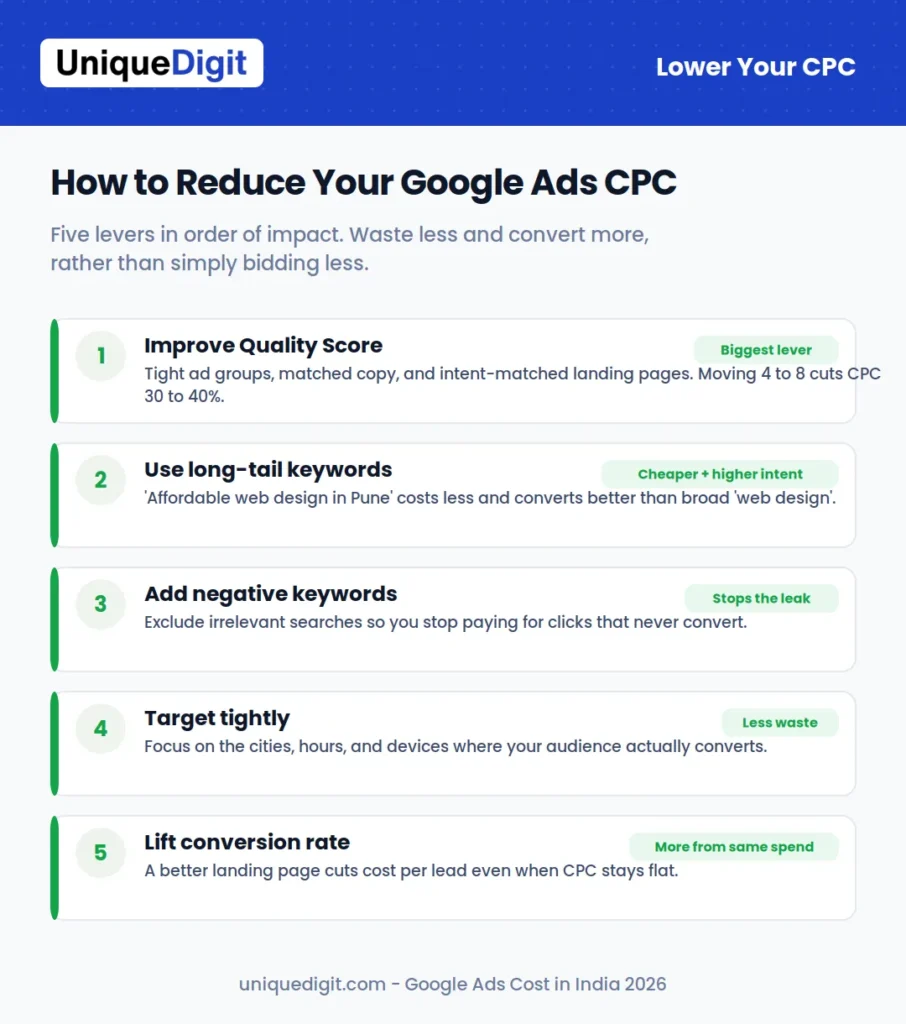
- Improve Quality Score. Tight ad groups, keyword-matched copy, and intent-matched landing pages drop your CPC without changing your bid. This is the single biggest cost lever on the platform.
- Use long-tail keywords. “Affordable web design for small business in Pune” costs less and converts better than the broad, expensive “web design.”
- Add negative keywords. Exclude irrelevant searches so you stop paying for clicks that never convert.
- Target tightly. Focus on the cities, hours, and devices where your audience actually converts rather than a blanket nationwide campaign.
- Lift conversion rate. A better landing page extracts more value from the same spend, cutting cost per lead even when CPC stays flat.
For the broader list of budget leaks to avoid, see our guide on SEO and marketing mistakes that kill results.
Conclusion
Google Ads cost in India is never a single number. It is set fresh in an auction every time someone searches, shaped by your industry, keyword competition, city, and Quality Score. Most businesses can plan around ₹7 to 150 per click and ₹15,000 to 1,00,000 per month, but the figure that decides success is cost per lead, not cost per click. Get your targeting tight, your landing page strong, and your budget concentrated, and even a modest spend can return real business.
At Unique Digit, we help Indian businesses spend on Google Ads where it actually returns. From Google Ads management that keeps your cost per lead falling to SEO that lowers your blended acquisition cost over time, we build the full picture rather than just running clicks. Start with a free audit and we will model realistic costs for your industry and city before you spend a rupee.