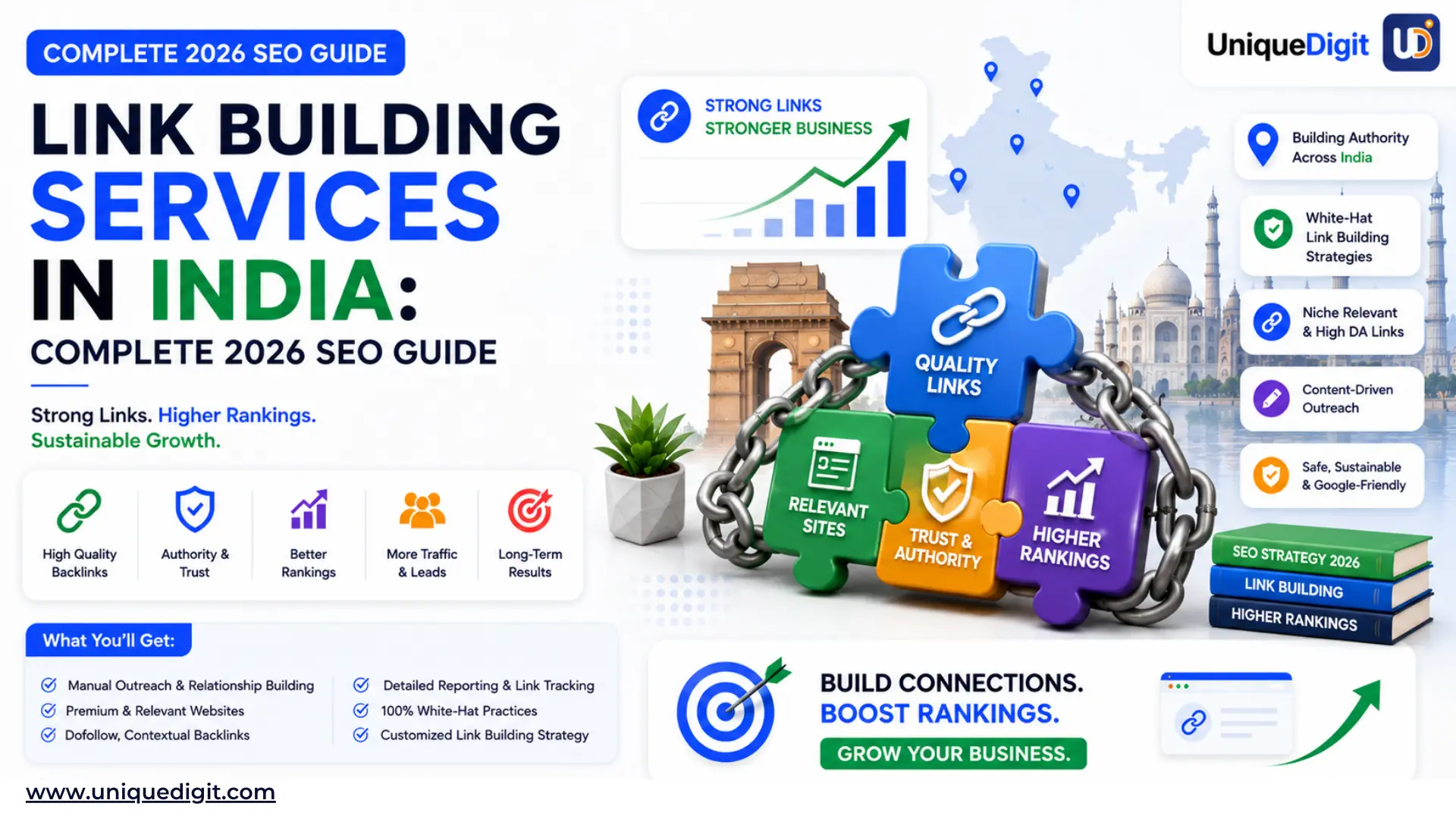
| Link building services in India help businesses earn backlinks from authoritative and relevant websites to improve Google rankings, increase organic traffic, and strengthen online authority. These services typically include guest posting, digital PR, niche edits, journalist outreach, broken link building, and local business citations.
In 2026, effective link building focuses on quality, relevance, and editorial credibility rather than bulk backlinks. Search engines now prioritize backlinks from trusted websites with real traffic, topical relevance, and natural placement within content. Editorial mentions and digital PR campaigns also influence visibility in AI-driven search platforms such as Google AI Overviews, ChatGPT, and Perplexity. |
Link building services in India help businesses earn high-quality backlinks that improve Google rankings, increase organic traffic, and boost visibility in AI search platforms like Google AI Overviews and ChatGPT.
In 2026, successful link building is no longer about buying bulk links. It is about earning trusted editorial mentions, relevant backlinks, and digital PR coverage that build long-term authority safely and sustainably.
What are link building services in India?
Link building services are done-for-you campaigns that earn backlinks to your website from other trusted sites. A backlink is a link from another website to yours, which search engines read as a vote of confidence. A link building agency runs the whole process for you: finding relevant sites, pitching them, and placing links inside real content.
Most providers combine guest posts, digital PR, journalist outreach, niche edits, and business directory listings. Work is sold monthly or per link. Reputable agencies build every link manually and follow Google’s guidelines, so your rankings improve without risking a penalty.
Why work with an Indian link-building agency?
An Indian link building agency builds backlinks that fit how your customers actually search in India, from publications and platforms that carry weight in the local market, not generic global sites.
Local relevance that ranks
Links from Indian publications, regional directories like Justdial, Sulekha, and IndiaMART, and city-specific news sites tell Google your business is established where your customers are. Google gives more weight to links that are topically and geographically relevant, so a handful of strong Indian links often outperform dozens of unrelated ones for local queries.
Access to Indian media
We hold relationships with Indian trade press, regional outlets, and publications like YourStory and Inc42, and pitch your business through data stories and expert commentary. Editorial coverage from recognised Indian sites is far harder for competitors to copy than directory links, and the brand mentions it creates are what Google AI Overviews and ChatGPT pull from when they answer Indian queries.
Search behaviour they understand
An Indian team knows how people here actually search, across English, Hindi, and regional languages, including the mixed and transliterated phrases most agencies miss. That shapes which sites we target and the anchor text we use, so your links match how Indians phrase the search, not a generic version of it.
Pricing in rupees, GST-compliant
You get clear packages billed in rupees with proper GST invoices you can claim as input tax credit. Pay by UPI or bank transfer, and choose monthly retainers or per-link pricing so the cost stays predictable and easy to budget.
Niche coverage for Indian businesses
From clinics and schools to ecommerce and real estate, we match link sources to your industry: health platforms for a clinic, education portals like Shiksha for a school, marketplaces for a D2C brand. Matching the niche keeps relevance high and the links looking natural, which is what protects your rankings long term.
Reachable local support
You work with a team in India, available during your business hours by WhatsApp, call, or email, in English or your regional language. Approvals and reports are handled the same working day, and there is always a real person to reach if a placement needs a change.
Types of Link Building Services in India
Link building services in India cover six main methods: guest posting, niche edits, digital PR, journalist outreach, directory citations, and broken link building. Each earns backlinks differently, and the right mix depends on your niche, budget, and how fast you need results.
- Guest posting. A guest post is an original article published on another website with a contextual link back to yours. It works because the link sits inside editorial content search engines trust, and readers of a relevant blog are already your audience. In India, the price and value track the host site’s Domain Rating (DR), a 0 to 100 score of link authority: a DR 50 niche blog is worth far more than five DR 15 general blogs. Best for steady, controllable links to specific pages.
- Niche edits (link insertions). A niche edit adds your link to an existing article that already ranks and gets traffic. Because the page is aged and indexed, it can pass authority faster than a fresh post. The catch: an edit is only worth buying if the host page has real organic traffic, so it should be checked in Ahrefs or Semrush first. Many cheap edits sit on dead pages and pass nothing.
- Digital PR. Digital PR turns original data, surveys, or expert views into stories journalists cover, earning several editorial links from one campaign. It also feeds AI search: AI-cited content is 25.7% fresher on average than pages ranking in organic Google results, and 80% of sources cited by AI platforms don’t appear in Google’s top results. Pitching Indian trade press, YourStory, and Inc42 reaches visibility that ordinary links miss.
- Journalist outreach. Reporters need expert sources, and a good quote earns a link from a high-authority news site. The landscape shifted recently: HARO (rebranded Connectively) shut down in December 2024 and relaunched free under Featured.com in April 2025.
- Directory citations. Consistent listings on Justdial, Sulekha, and IndiaMART build foundational trust and NAP (name, address, phone) consistency that supports local and map rankings. On their own they are low value and easily copied. They support a profile; they do not build one.
- Broken link building. This finds a dead link on a relevant site and offers your content as the replacement. Success rates are high because it fixes a real problem for the site owner.
How the Link Building Process Works
A professional link building campaign runs through six stages, from a backlink audit to monthly reporting. Knowing each stage is the simplest way to tell a genuine service from a spam vendor.
Step 1: Backlink audit.
The campaign starts by reviewing the existing backlink profile: referring domains, anchor text spread, and toxic links worth disavowing (formally telling Google to ignore them). This matters because a spammy profile can cap rankings before a single new link is built. A provider who sells links without auditing first is a warning sign.
Step 2: Strategy and targets.
Next comes the plan: which pages to rank, for which keywords, and how many links of what type each needs. The anchor text mix is set here too, because over-using exact-match anchors is a known penalty trigger. Look for a plan tied to business goals, not a flat “50 links a month.”
Step 3: Prospecting and vetting.
Every candidate site is checked for real organic traffic, genuine authority, topical relevance, and a clean outbound-link profile. Sites in unrelated niches, or ones that openly sell “paid posts” at scale, are ruled out. This vetting is where most of the quality difference between providers actually sits.
Step 4: Outreach.
Sites are pitched by hand, and the relationship earns a natural placement. Manual outreach matters because automated mass emails get low reply rates and risky placements. Fluent English and regional-language outreach is where Indian teams have an edge on the same sites.
Step 5: Placement and quality check.
Before a link counts, it should be live, do-follow where agreed, in relevant context, on an indexed page, with natural surrounding content, and compliant with Google’s link guidelines. Links reported but not live, or buried among dozens of unrelated outbound links, are red flags.
Step 6: Reporting.
A monthly report should list every link built, with its page, anchor text, the site’s DR, and how rankings and traffic are moving, so the return on spend is measurable rather than assumed.
Link Building for Your Industry
The most valuable backlinks come from sites relevant to your industry, so link building in India works best when the sources match the niche. A relevant link from a mid-authority industry site outperforms a high-authority link from an unrelated one. Here is what that looks like across common sectors.
- Doctors and clinics. Healthcare is a YMYL (Your Money or Your Life) niche, where Google holds trust signals to a higher bar, so relevance and consistency matter more than raw volume. The core platforms are Practo, which lists over 150,000 doctors and supports real-time appointment booking, Lybrate for patient Q&A, and Justdial. Consistent NAP (name, address, phone) across these is a confirmed local SEO ranking signal, and most practices are listed on fewer than ten directories, leaving a visibility gap. Add health-publication guest posts and local news for editorial depth
- Schools and coaching institutes. Education searches spike around admission cycles, so links from education portals like Shiksha and CollegeDekho, parenting forums, and regional news carry the most weight when parents are actively comparing. Exam-prep and scholarship resource pages are strong link targets because they are built to link out.
- Restaurants and cafes. Discovery here runs through Zomato and Swiggy listings, city food guides, and local food blogs, the sources diners check before booking. Reviews and citations on these platforms feed both local rankings and the maps pack.
- Salons and beauty. Beauty and lifestyle blogs, local directories, and booking platforms like UrbanCompany are where customers compare services. Visual, before-and-after content earns natural links and shares in this niche.
- Ecommerce and D2C brands. Product roundups, gift guides, and comparison articles drive both links and referral sales. Marketplaces like IndiaMART support B2B reach, while digital PR built on original data earns coverage on shopping and lifestyle sites.
- Real estate. Property portals, locality and city guides, and finance or home-improvement sites relevant to buyers researching a purchase. Local relevance is decisive, since real estate demand is geographically fixed.
Bottom line: the right link is the one your customers already trust, so match the source to the sector before chasing Domain Rating.
Link Building and AI Search: What Changed in 2026
Link building in 2026 is no longer only about Google rankings. It now shapes whether a brand gets cited by AI search tools like Google AI Overviews, ChatGPT, and Perplexity, which pull answers from a different set of sources than the classic ten blue links. That shift changes which links are worth building.
Brand mentions now matter as much as links.
AI systems weigh where a brand is mentioned across credible publications, not just who links to it. A 2026 analysis found that brand mentions from authoritative sites correlate about three times more strongly with AI visibility than backlinks alone. Digital PR, which earns editorial coverage, is therefore the method that builds Google authority and AI visibility at the same time.
AI cites sources Google often does not rank
Optimizing for one surface no longer guarantees the other. Around 80% of sources cited by AI platforms do not appear in Google’s top results, and only 12% match Google’s top-ranking pages. Being cited depends on being mentioned widely, not only on ranking first.
Freshness carries more weight
Content cited by AI is on average 25.7% fresher than pages ranking in organic Google results. Recent editorial coverage and updated pages are more likely to be pulled into an AI answer.
Journalist outreach changed too
HARO (Help a Reporter Out), long a staple for earning news links, was rebranded Connectively and shut down in December 2024, then relaunched free under Featured.com in April 2025. Qwoted and Indian journalist requests on X are also active channels for expert quotes.
The links that earn AI citations are editorial brand mentions from credible, relevant publications, not bulk directory links.
How Much Do Link Building Services Cost in India?
Link building services in India are priced either per link or as a monthly retainer. The cost depends mainly on the linking site’s Domain Rating (DR), its real organic traffic, and your niche. Indian agencies generally deliver quality comparable to Western providers at a lower cost, which is the main reason the market exists.
Four factors drive the price:
Site authority and traffic. A link from a high-DR site with genuine organic visitors costs far more than one from a weak or fake-traffic site.
Method used. Guest posts, niche edits, and digital PR each carry different costs and effort.
Niche competitiveness. Finance, legal, and health are Your Money or Your Life (YMYL) topics and cost more, because publishers apply stricter standards and demand higher premiums.
Volume and speed. More links, faster, means a higher budget.
Typical cost by method:
| Method | Indicative cost per link (₹) | Notes |
| Directory citations | ₹0 to ₹1,500 | Foundational trust, not ranking power |
| Niche edits | ₹8,000 to ₹35,000 | Faster impact, page already indexed |
| Guest posts | ₹12,000 to ₹45,000 | Higher-DR sites cost more, few pitches accepted |
| Digital PR | ₹60,000+ per campaign | Priciest, but builds AI-search visibility |
How to Choose a Link Building Company in India
Choose a link building company in India by checking how it earns links, not how many it promises. The right partner uses manual, white-hat methods, places links on relevant sites with real traffic, and shows you exactly what was built. The wrong one sells cheap volume that risks a penalty. Use the checklist below to tell them apart.
Green flags, signs of a genuine provider:
- They audit before they sell. A real agency reviews your backlink profile and goals first, rather than quoting “50 links a month” on the first call.
- They name their methods. Guest posts, niche edits, and digital PR, explained clearly, with no vague talk of “secret techniques.”
- They vet sites for real traffic. Every target is checked in Ahrefs or Semrush for genuine organic visitors, not just a high DR number.
- They show sample reports. You can see live link URLs, anchor text, and the site’s authority before you commit.
- They diversify anchor text. Branded and generic anchors dominate, with exact-match used sparingly.
- They have verifiable proof. Real reviews on Clutch or G2 and case studies you can check.
Red flags, signs to walk away:
- Guaranteed rankings or “500 links for ₹5,000.” No one can guarantee rankings, and bulk-link offers mean link farms.
- No client references or hidden methods. If they will not show placements or explain how they work, assume the worst.
- Links reported but not live. Or links buried among dozens of unrelated outbound links on a page.
- Only DR is quoted, never traffic. A DR 70 site with 300 monthly visitors passes little value.
Three questions worth asking any agency:
- Can you show me three live links you have built for a client in my niche?
- How do you decide a site is worth a placement?
- How does your link building support visibility in AI search, not just Google?
Bottom line: a provider that explains its process and shows its work is worth more than one that promises the most links for the lowest price.
Conclusion
Link building in 2026 is no longer just an SEO tactic. It is a complete authority-building strategy that influences Google rankings, local visibility, and AI search citations simultaneously. Businesses that invest in relevant, editorial-quality backlinks gain stronger trust signals, sustainable organic growth, and long-term competitive advantages.
At Unique Digit, we focus on white-hat link building strategies that combine manual outreach, digital PR, niche relevance, and AI-search optimization to help brands grow safely and consistently in modern search ecosystems.
FAQs
Are link building services in India safe?
Yes, link building services in India are safe when the provider uses manual, white-hat methods.
- Safe providers earn editorial links from relevant sites with real traffic and follow Google’s guidelines.
- The risk comes from cheap services using PBNs, link farms, or bulk paid links, which can trigger a penalty.
- Before hiring, ask exactly how each link is earned and where it is placed.
How much do link building services cost in India?
Quality link building in India typically costs ₹8,000 to ₹45,000 per link, or a monthly retainer.
- Directory citations: ₹0 to ₹1,500, foundational only.
- Niche edits: ₹8,000 to ₹35,000.
- Guest posts: ₹12,000 to ₹45,000, higher on high-DR sites.
- Digital PR: from ₹60,000 per campaign.
- Indian agencies usually charge less than US and UK providers for the same quality.
How long does link building take to show results?
Most sites see ranking movement in three to six months, with fuller results over six to twelve months.
- Why it takes time: Google must find, crawl, and value each new link before rankings respond.
- Competitive niches like finance and health take longer.
- Warning sign: any provider promising results in a few weeks.
What makes a backlink high quality?
A high-quality backlink comes from a relevant, authoritative site with real organic traffic, placed naturally inside content.
- Relevance to your niche matters most.
- Genuine authority and traffic come next, so check real traffic, not just DR.
- Placement: a do-follow link inside editorial content beats a footer or sidebar link.
Do backlinks still matter for SEO in 2026?
Yes, backlinks remain one of Google’s strongest ranking signals in 2026.
- They help Google judge a site’s authority and discover its pages.
- The emphasis has shifted to quality and relevance over quantity.
- Editorial links now also influence visibility in AI search answers.
Do link building services help with AI search like ChatGPT and AI Overviews?
Yes, editorial links and brand mentions influence whether AI tools cite your brand.
- AI Overviews, ChatGPT, and Perplexity favour brands mentioned across credible publications.
- Digital PR earns that coverage, building Google and AI visibility together.
- Bulk directory links do little for AI citation.