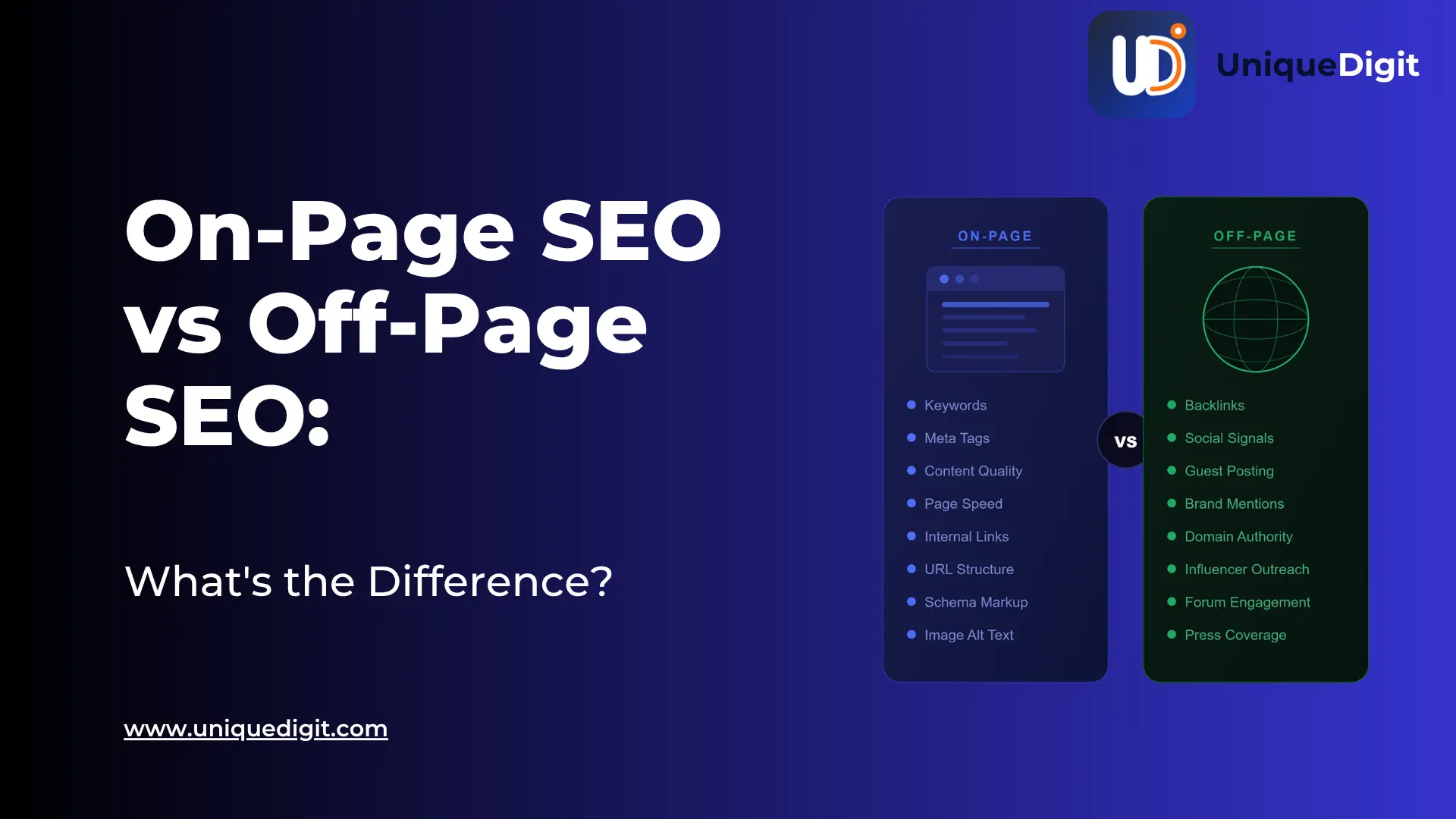
| The short answer: On-Page SEO is everything you do on your website to help it rank its content, keywords, headings, meta tags, internal links, and page speed. Off-Page SEO is everything you do outside your website to build authority, mainly backlinks, brand mentions, social signals, and reputation. You need both. On-Page makes your pages eligible to rank; Off-Page makes them competitive enough to actually rank. |
If you have ever wondered why your competitor outranks you despite having weaker content, or why a beautifully designed website still doesn’t get traffic, the answer almost always lies in the balance between On-Page SEO and Off-Page SEO.
This guide breaks down both the difference between On-Page SEO and Off-Page SEO, the exact factors that influence each, and how Indian businesses like schools, clinics, local services, and e-commerce brands can use them together to win on Google in 2026.
What Is SEO?
SEO (Search Engine Optimization) is the practice of improving your website so that it appears higher in search results on Google, Bing, and other search engines. Higher rankings = more clicks = more leads, admissions, patients, or sales — without paying for ads.
There are three main types of SEO:
- On-Page SEO — Optimizing individual pages (content, HTML, structure).
- Off-Page SEO — Building your site’s authority and reputation from external sources.
- Technical SEO — Making sure Google can crawl, render, and index your site properly (site speed, mobile-friendliness, schema, XML sitemaps).
Technical SEO is sometimes treated as a subset of On-Page SEO, but most modern guides, and Google’s own Search Central documentation, recognize all three as distinct disciplines. In this guide, we focus on the two pillars most often confused: On-Page SEO and Off-Page SEO.
What Is On-Page SEO?
On-Page SEO is the process of optimizing the content and HTML source code of individual web pages so that they rank higher and earn more relevant traffic from search engines. Everything happens within your website — you have full control over it.
Think of On-Page SEO as making your shop’s interior, signboard, and product labels so clear that any customer (or in this case, Google) instantly understands what you offer and whether it matches their need.
Why On-Page SEO Matters
- It tells Google what your page is about.
- It directly influences how relevant Google thinks your page is for a given query.
- It is the only part of SEO that is 100% in your hands, no waiting for someone else to link to you.
- Without solid On-Page SEO, no amount of Off-Page work will save you.
On-Page SEO Factors
Here are the on-page SEO factors that move the needle the most in 2026:
1. High-Quality, Intent-Matched Content
Content remains the single biggest On-Page factor. Your page must satisfy the search intent, informational, navigational, commercial, or transactional. A blog explaining “symptoms of dengue” should not try to sell consultations in the first paragraph; that mismatches intent.
2. Title Tag
- Place the primary keyword near the front.
- Keep it under 60 characters so it doesn’t get truncated in SERPs.
- Make it unique for every page.
3. Meta Description
- 150–160 characters.
- Includes the primary keyword + a clear value proposition + a soft call-to-action.
- Not a direct ranking factor, but a strong CTR driver.
4. URL Structure
- Short, readable, keyword-informed: /on-page-seo-vs-off-page-seo beats /p?id=2837.
- Use hyphens (not underscores).
- Avoid stop words and dates if you plan to update the page.
5. Heading Hierarchy (H1, H2, H3)
- One H1 per page, containing the primary keyword.
- H2s for major sections, H3s for sub-sections.
- Use related keywords and natural-language questions in subheadings — this helps you win Featured Snippets and AI Overview citations.
6. Keyword Optimization (Without Stuffing)
- Place the primary keyword in the first 100 words, naturally.
- Use semantically related terms (LSI keywords) throughout.
- Write for humans first; Google’s NLP is sophisticated enough to recognise topical depth.
7. Internal Linking
- Link contextually to other relevant pages on your site.
- Use descriptive anchor text — not “click here”.
- Every important page should be reachable within 3 clicks from the homepage.
8. Image Optimization
- Compress images (WebP or AVIF format).
- Add descriptive alt text with keywords where natural.
- Use meaningful file names: bhopal-cbse-school-classroom.jpg, not IMG_4421.jpg.
- Specify width and height to prevent layout shifts (CLS).
9. Page Speed & Core Web Vitals
Google’s official thresholds:
- LCP (Largest Contentful Paint): under 2.5s
- INP (Interaction to Next Paint): under 200ms
- CLS (Cumulative Layout Shift): under 0.1
A slow page on a 4G connection — common across many parts of India — will lose rankings no matter how good the content is.
10. Mobile-Friendliness
With Google’s mobile-first indexing, your mobile site is your site. Test with Google’s Mobile-Friendly Test and ensure tap targets, font sizes, and layouts work on small screens.
11. Schema Markup (Structured Data)
Add JSON-LD schema for Article, FAQPage, BreadcrumbList, LocalBusiness, or industry-specific types (MedicalClinic, EducationalOrganization). This unlocks rich results and improves visibility in AI Overviews.
12. Content Freshness
Keep important pages updated. Use datePublished and dateModified schema. Google rewards freshness for time-sensitive queries.
What Is Off-Page SEO?
Off-Page SEO refers to all the activities done outside your own website to improve its ranking in search engine results. It’s everything Google can see about you on the wider web — who links to you, who mentions you, who reviews you, and how trusted your brand is.
If On-Page SEO is your shop’s interior, Off-Page SEO is your reputation in the market — what other people, businesses, and publications say about you when you’re not in the room.
Why Off-Page SEO Matters
- It signals authority and trust (the “A” and “T” in E-E-A-T).
- It tells Google that others find your content valuable enough to reference.
- For competitive keywords, Off-Page is often the tiebreaker between two well-optimized pages.
Off-Page SEO Factors
Here are the Off-Page SEO factors that matter most in 2026:
1. Backlinks (Still the #1 Off-Page Factor)
A backlink is a link from another website to yours. Not all backlinks are equal:
- Quality > quantity. One link from The Hindu, Times of India, or a relevant industry blog beats 100 links from spammy directories.
- Relevance matters. A backlink from a healthcare publication to a doctor’s website carries more weight than one from an unrelated blog.
- Anchor text should be natural and varied, not always an exact match.
2. Brand Mentions (Linked and Unlinked)
Google can detect when your brand is mentioned online, even without a hyperlink. Consistent mentions across credible sources build entity authority.
3. Local Citations (NAP Consistency)
For Indian businesses, listings on Justdial, Sulekha, IndiaMart, Practo (for doctors), Lybrate, Shiksha (for schools), and Google Business Profile must have identical Name, Address, and Phone (NAP). Inconsistent citations confuse Google and hurt local rankings.
4. Google Business Profile (GBP) Optimization
Though technically a Google property, GBP optimization is the cornerstone of local Off-Page SEO:
- Complete every field (category, hours, services, photos).
- Publish weekly GBP posts.
- Respond to every review — positive or negative.
- Add Q&A and seed it yourself.
5. Online Reviews and Reputation
Reviews on Google, Practo, Justdial, and industry-specific platforms are a major Off-Page signal. Volume, recency, average rating, and your response rate all matter.
6. Social Media Signals
While social shares are not a direct ranking factor, a strong social presence:
- Drives traffic that can convert into backlinks.
- Builds brand recognition (which influences branded search volume — a real signal).
- Helps Google verify entity legitimacy via sameAs schema linking to your social profiles.
7. Guest Posting and Digital PR
Writing for relevant industry publications, getting quoted in news articles, and contributing expert commentary all of these earn high-quality contextual backlinks plus brand authority.
8. Influencer Marketing & Partnerships
Collaborations with niche influencers or partner brands often generate backlinks, mentions, and referral traffic — all Off-Page positives.
9. Forum Participation and Community Engagement
Genuine, helpful participation on platforms like Quora, Reddit, and niche communities can build referral traffic and occasional backlinks. Avoid spammy linking; Google has been clamping down hard.
10. Video and Podcast Mentions
Being featured on YouTube channels or podcasts in your niche increases brand visibility, drives branded searches, and often results in contextual backlinks from show notes.
Difference Between On-Page SEO and Off-Page SEO
Here’s a side-by-side look at the difference between On-Page SEO and Off-Page SEO:
| Aspect | On-Page SEO | Off-Page SEO |
| Where it happens | On your own website | Outside your website |
| Level of control | Full control | Limited control (depends on others) |
| Primary purpose | Tells Google what your page is about | Tells Google how trustworthy your page is |
| Main signals | Content, title tags, headings, internal links, schema, speed | Backlinks, brand mentions, reviews, citations, social signals |
| Time to impact | Faster — changes can show within days/weeks | Slower — usually takes weeks to months |
| Cost | Mostly time/expertise | Time + outreach effort, occasionally PR investment |
| Key skill required | Content writing, basic HTML, UX | Outreach, networking, PR, branding |
| Examples | Optimizing a title tag, adding FAQ schema, and compressing images | Earning a backlink from a news site, getting Google reviews |
| Risk if neglected | Page is invisible/irrelevant to Google | Page can’t compete with authoritative competitors |
| Best for | Establishing relevance | Building authority |
In one line: On-Page SEO earns relevance; Off-Page SEO earns authority. Google ranks pages that have both.
On-Page SEO vs Off-Page SEO: Which Is More Important?
This is the most-asked question, and the honest answer is: neither, in isolation. They’re two sides of the same coin.
- A beautifully optimized page with no backlinks will struggle to rank for anything competitive.
- A page with great backlinks but poor on-page content will rank briefly, then get outperformed by a more relevant competitor.
That said, the sequence matters. Always fix On-Page SEO first. Building backlinks to a page with the wrong title tag, missing schema, or thin content is like pouring water into a leaky bucket. Once the on-page foundation is solid, invest in Off-Page activities to amplify.
For most small and mid-sized Indian businesses, a practical split looks like this:
- First 60 days: 80% On-Page, 20% Off-Page (mostly GBP setup and core citations)
- Day 60 onwards: 40% On-Page (ongoing content), 60% Off-Page (link building, PR, reviews)
How On-Page and Off-Page SEO Work Together
The strongest SEO results come when both reinforce each other:
- You publish a well-researched, on-page-optimized guide (On-Page).
- Another site links to it because it’s genuinely useful (Off-Page).
- The backlink drives referral traffic and improves rankings.
- Higher rankings attract more eyeballs — and more potential backlinks.
- You update the guide with fresh data (On-Page freshness signal).
- Google sees a consistently authoritative, relevant page and ranks it higher still.
This is the SEO flywheel. Skip either side and the wheel stalls.
Common Mistakes Indian Businesses Make
- Keyword stuffing in titles and content (a relic of 2010-era SEO that now actively hurts rankings).
- Buying low-quality backlinks from PBNs or Fiverr gigs — almost always leads to penalties.
- Ignoring Google Business Profile despite serving a clearly local audience.
- Inconsistent NAP across Justdial, Sulekha, IndiaMart, and the website.
- Not responding to reviews — Google treats this as a signal of inactive management.
- Treating SEO as a one-time setup instead of an ongoing program.
- Chasing keywords without intent mapping — ranking for the wrong query produces traffic that never converts.
Best Practices For On-Page and Off-Page SEO
- Mobile-first, always. A large share of Indian search traffic is on budget smartphones with patchy connectivity. Optimize for that reality.
- Use Hindi or regional language content strategically — especially for local services. Voice search in regional languages is rising fast.
- Prioritize GBP + Justdial + Practo (or industry-specific directories) before chasing big-publication backlinks.
- Earn reviews from real customers — never incentivize, never fake. Google’s spam detection now flags suspicious review patterns.
- Add schema for everything eligible — LocalBusiness, FAQPage, BreadcrumbList, Article. Indian sites consistently under-use schema, which is an easy edge.
- Build relationships with regional and niche publications — Indian media is far more responsive to genuine expert pitches than people assume.
Final Thoughts
The On-Page SEO vs Off-Page SEO debate isn’t really a debate; it’s a partnership. On-Page makes you eligible to rank. Off-Page makes you competitive enough to actually rank. The brands that win on Google in 2026 — whether a CBSE school in Bhopal, a multi-specialty hospital in Mumbai, or a D2C brand shipping pan-India- are the ones treating both as a single, integrated program, not two separate checklists.
Start with On-Page. Get your house in order. Then earn your reputation through Off-Page work. Repeat the cycle, measure in Google Search Console, and let compounding do its job.
Need help implementing this for your business?
Talk to Unique Digit, we build integrated On-Page and Off-Page SEO programs for Indian schools, healthcare practices, and growing brands.
FAQs
What is the main difference between On-Page SEO and Off-Page SEO?
On-Page SEO covers everything you do on your website — content, keywords, meta tags, headings, internal links, page speed, and schema. Off-Page SEO covers everything done outside your website — backlinks, brand mentions, online reviews, local citations, and social signals. On-Page builds relevance; Off-Page builds authority.
Is On-Page SEO or Off-Page SEO more important?
Both are essential. On-Page SEO should be fixed first because it’s fully in your control and establishes the foundation. Off-Page SEO becomes critical for competitive keywords where multiple sites have similar on-page quality. Without On-Page, Off-Page can’t help; without Off-Page, On-Page alone rarely wins competitive queries.
What are the most important On-Page SEO factors?
The biggest On-Page SEO factors are: high-quality intent-matched content, optimized title tags and meta descriptions, proper heading hierarchy (H1, H2, H3), internal linking, image optimization with alt text, page speed (Core Web Vitals), mobile-friendliness, and structured data (schema markup).
What are the most important Off-Page SEO factors?
The most important Off-Page SEO factors are: quality backlinks from authoritative and relevant websites, Google Business Profile optimization, online reviews (especially on Google, Practo, and Justdial for Indian businesses), brand mentions, consistent NAP citations, and social media presence.
How long does Off-Page SEO take to show results?
Off-Page SEO usually takes 3 to 6 months to show meaningful results. Backlinks need to be crawled, evaluated, and trusted by Google. Local citations and reviews can influence Google Business Profile rankings faster — often within a few weeks.
Can I do SEO without backlinks?
You can rank for low-competition, long-tail, and hyper-local keywords using strong On-Page SEO and Google Business Profile optimization alone. For competitive head terms, however, backlinks remain essential — and skipping Off-Page SEO will cap your growth.
What are the three types of SEO?
The three types of SEO are: On-Page SEO (optimizing content and HTML on your site), Off-Page SEO (building external authority through backlinks and reputation), and Technical SEO (ensuring Google can crawl, render, and index your site through speed, mobile-friendliness, and structured data).
Is social media part of Off-Page SEO?
Yes, social media is part of Off-Page SEO. While social shares are not a direct Google ranking factor, social presence drives referral traffic, increases brand searches, supports entity verification via sameAs schema, and often leads to backlinks — all of which indirectly improve rankings.