
Digital marketing objectives are specific, measurable targets that define what a business wants to achieve through its online marketing efforts within a set timeframe. Unlike goals, which provide overall direction, objectives are actionable, while KPIs measure progress toward those objectives.
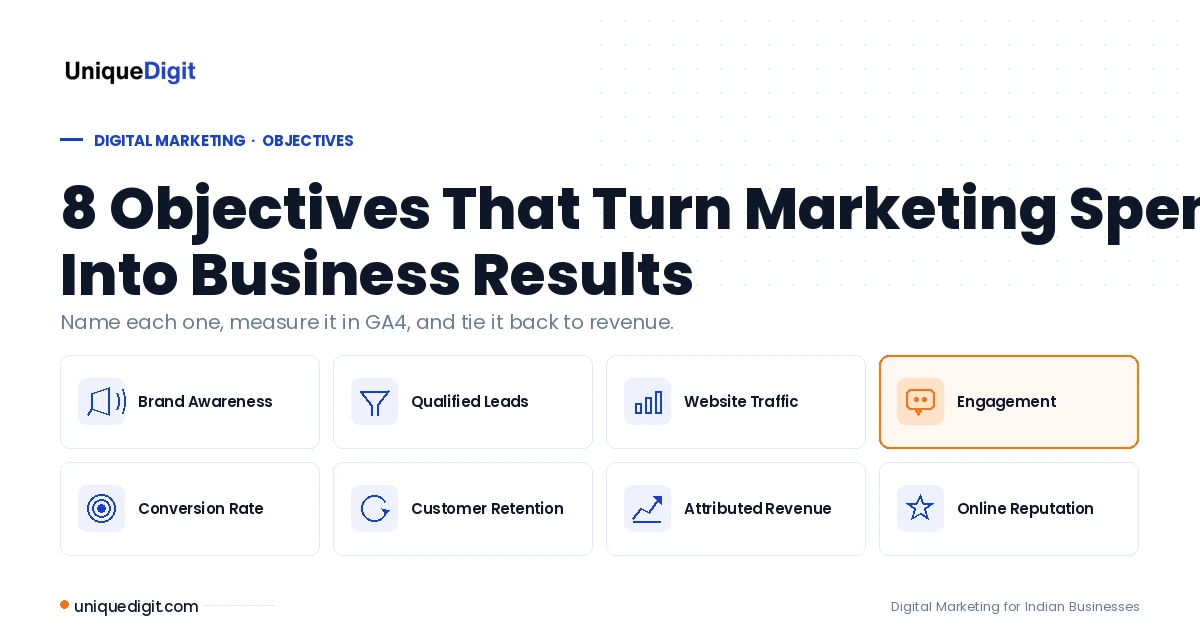
The main objectives of digital marketing include:
- Increasing brand awareness
- Driving qualified website traffic
- Generating high-quality leads
- Improving customer engagement
- Increasing conversion rates
- Retaining existing customers
- Growing marketing-attributed revenue
- Building a strong online reputation
The most effective way to set digital marketing objectives is by using the SMART framework, ensuring each objective is Specific, Measurable, Achievable, Relevant, and Time-bound. For example of Digital marketing objective, instead of aiming to "get more leads," a SMART objective would be to generate 200 qualified leads through Google Ads within six months at a target cost per lead.
Most businesses invest in digital marketing without defining what success actually looks like. They launch SEO campaigns, run Google Ads, publish social media content, and send emails, but struggle to answer a simple question: Is our marketing delivering real business results?
That's where digital marketing objectives come in. They give every campaign a clear purpose, measurable target, and timeline for success. In this guide, you'll learn what digital marketing objectives are, the eight objectives every business should track, how to write SMART objectives, and the common mistakes that prevent marketing from delivering measurable growth.
What Are Digital Marketing Objectives?
Digital marketing objectives are specific, measurable results that a business aims to achieve through its online marketing activities within a defined timeframe. They clearly define what your marketing efforts should accomplish, whether that's increasing website traffic, generating more leads, improving sales, or building brand awareness.
Digital marketing objectives are often confused with goals and KPIs, but they serve different purposes.
- Goals describe the overall business outcome you want to achieve
- Objectives define the measurable targets that support those goals
- KPIs (Key Performance Indicators) track how well you're progressing toward those objectives. Having clear objectives helps keep your marketing strategy focused and makes success easier to measure.
| Term | What It Answers | Example |
|---|---|---|
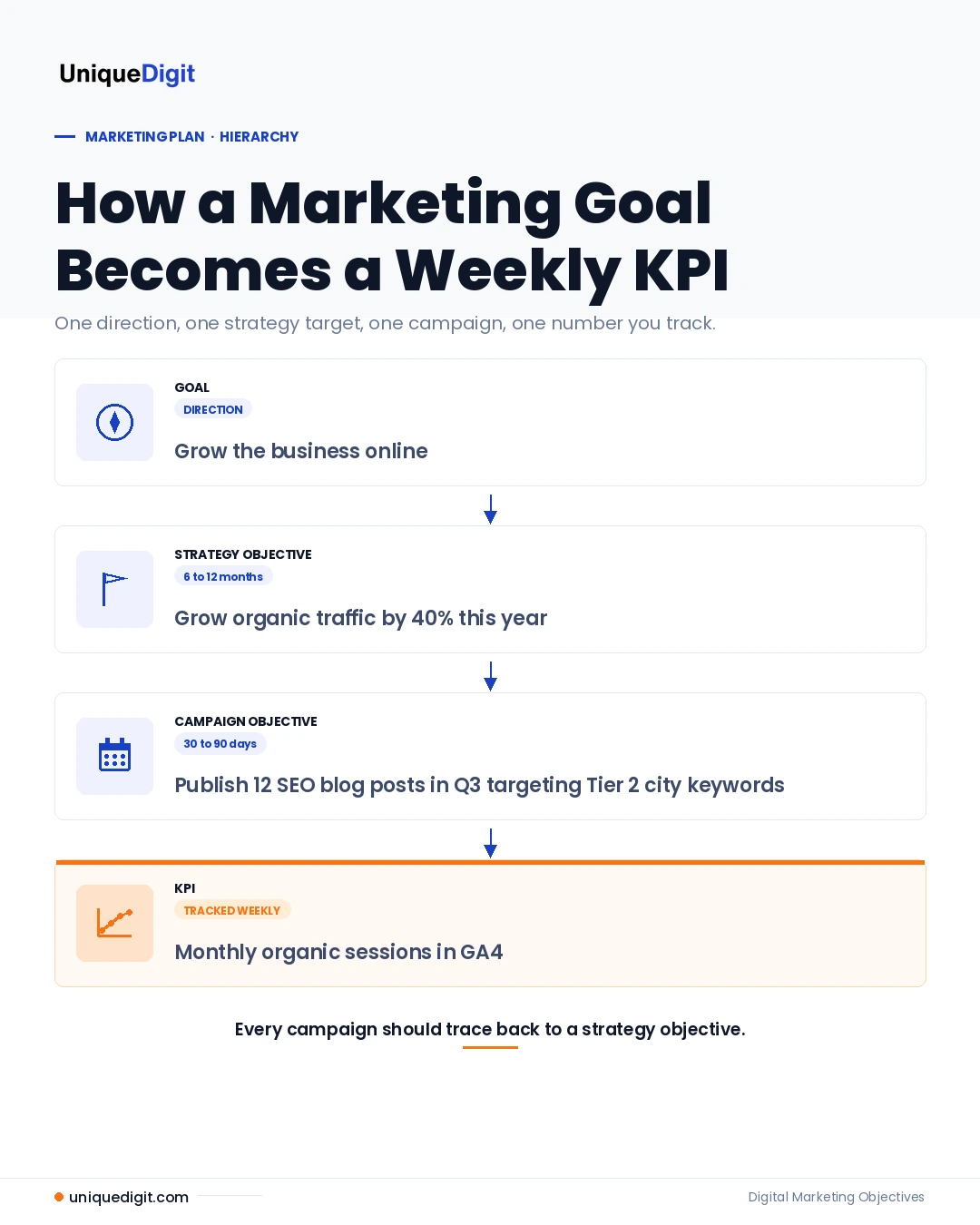
| Goal | Where are we heading? | Grow the business online |
| Objective | What specific result will we hit? | Increase organic website traffic by 40% in 6 months |
| KPI | How do we track progress? | Monthly organic sessions in GA4 |
What Are the Main Objectives of Digital Marketing?
The main objectives of digital marketing are to increase brand awareness, attract qualified traffic, generate leads, drive sales, improve customer engagement, build trust, retain existing customers, and measure marketing performance.
Let's understand each objective clearly!
01 Build Brand Awareness
Brand awareness means getting your business in front of people who do not know you yet. It is the starting point of every marketing funnel, and without it, nothing else works.
This objective matters most for new businesses, businesses entering a new city or market, and businesses launching a new product line. The mistake most teams make is measuring awareness through follower counts alone. Branded search volume is a far more reliable signal because it shows people are actively looking for you by name.
How to measure it: branded search volume in Google Search Console, social reach in Meta Business Suite.
Example: A Jaipur-based coaching institute tracks branded search queries after running a 60-day YouTube Shorts campaign and sees a 35% increase in "institute name + reviews" searches.
02 Generate Qualified Leads
Lead generation is about attracting people who are ready to enquire, sign up, or request a quote. The word "qualified" matters. A thousand form submissions mean nothing if none of them convert to paying customers.
The objective here is not just volume but quality. That means tracking cost per lead alongside total leads and filtering by source to see which channels bring buyers versus browsers.
How to measure it: qualified leads per month and cost per lead in GA4 conversion reports or CRM.
Example: A dental clinic in Delhi runs Google Ads pointing to a WhatsApp lead form and generates 180 qualified appointment requests in a month at ₹120 per lead.
03 Increase Website Traffic
Traffic is the fuel for every other objective on this list. Without enough of the right visitors landing on your site, lead forms stay empty and sales pages go unseen.
The key distinction is "right visitors." A spike in traffic from irrelevant keywords or geographies inflates numbers without moving revenue. The objective should specify traffic from a target audience, channel, or geography.
How to measure it: organic sessions and new users by channel in GA4, impressions and clicks in Google Search Console.
Example: A Pune-based SaaS company publishes 12 blog posts in Hindi targeting Tier 2 city queries and grows organic traffic from non-metro cities by 45% in one quarter.
04 Improve Customer Engagement
Engagement measures whether visitors actually interact with your content or leave immediately. High engagement signals that your content matches what the audience was looking for, and it feeds directly into better search rankings, stronger brand recall, and higher conversion rates downstream.
This objective goes beyond social media likes. On-site engagement (time on page, pages per session, scroll depth) tells you whether your website content is doing its job.
How to measure it: engagement rate and average engagement time in GA4, social interactions in Meta Business Suite.
Example: A D2C skincare brand starts running weekly Instagram Reels with polls and "this or that" stickers, increasing average engagement rate from 1.8% to 4.2% over two months.
05 Increase Conversion Rate
Conversion rate optimization is about getting more of your existing visitors to take the desired action, whether that is purchasing, booking, signing up, or downloading. It is one of the highest-ROI objectives because it does not require more traffic, just better performance from the traffic you already have.
Small changes often produce outsized results here. Page speed, form length, payment options, and trust signals (reviews, security badges, GST details) all influence whether a visitor converts or leaves.
How to measure it: conversion rate by channel and device in GA4 funnel exploration reports.
Example: A Shopify India store moves UPI to the default payment option at checkout and sees a 18% increase in completed orders within three weeks, with no change in traffic.
06 Retain Existing Customers
Acquiring a new customer costs five to seven times more than keeping an existing one. Yet most digital marketing plans pour budget into acquisition and ignore retention entirely.
Retention objectives focus on repeat purchases, subscription renewals, rebooking rates, and reducing churn. The channels that drive retention are typically email, WhatsApp, SMS, and loyalty programmes, not search or social ads.
How to measure it: repeat purchase rate and customer lifetime value in CRM, returning user cohorts in GA4.
Example: A salon chain in Bengaluru sets up automated WhatsApp reminders 21 days after each appointment and increases rebooking rates from 30% to 52% in one quarter.
07 Grow Marketing-Attributed Revenue
Revenue is the objective that ties every other objective back to business outcomes. Marketing-attributed revenue measures how much money came in as a direct result of marketing activity, not just "we ran ads and revenue went up."
This requires proper attribution setup. Without it, marketing teams cannot prove their contribution and finance teams cannot justify the spend.
How to measure it: marketing-attributed revenue and ROAS in GA4 attribution reports, Meta Conversions API (CAPI) for ad-driven revenue.
Example: A restaurant chain in Hyderabad tracks Zomato ad spend against weekly in-store footfall using coupon codes and finds that every ₹1 spent on Zomato Ads returns ₹4.6 in dine-in revenue.
08 Build Online Reputation
Online reputation is the objective most businesses think about only after a crisis. But proactively managing reviews, ratings, and public perception is a growth driver, not just damage control.
For local businesses in India, Google Business Profile reviews, Justdial ratings, and platform-specific scores (Practo for healthcare, Zomato for restaurants, Shiksha for education) directly influence whether a potential customer picks you or a competitor.
How to measure it: average review rating, review volume, and sentiment trends in GBP dashboard, Practo analytics, or Zomato restaurant dashboard.
Example: A multi-location hospital in Chennai sets a monthly target of 20 new Google reviews per branch and assigns front-desk staff to request feedback post-consultation, moving their average rating from 3.8 to 4.4 in six months.
How Do You Set Digital Marketing Objectives?
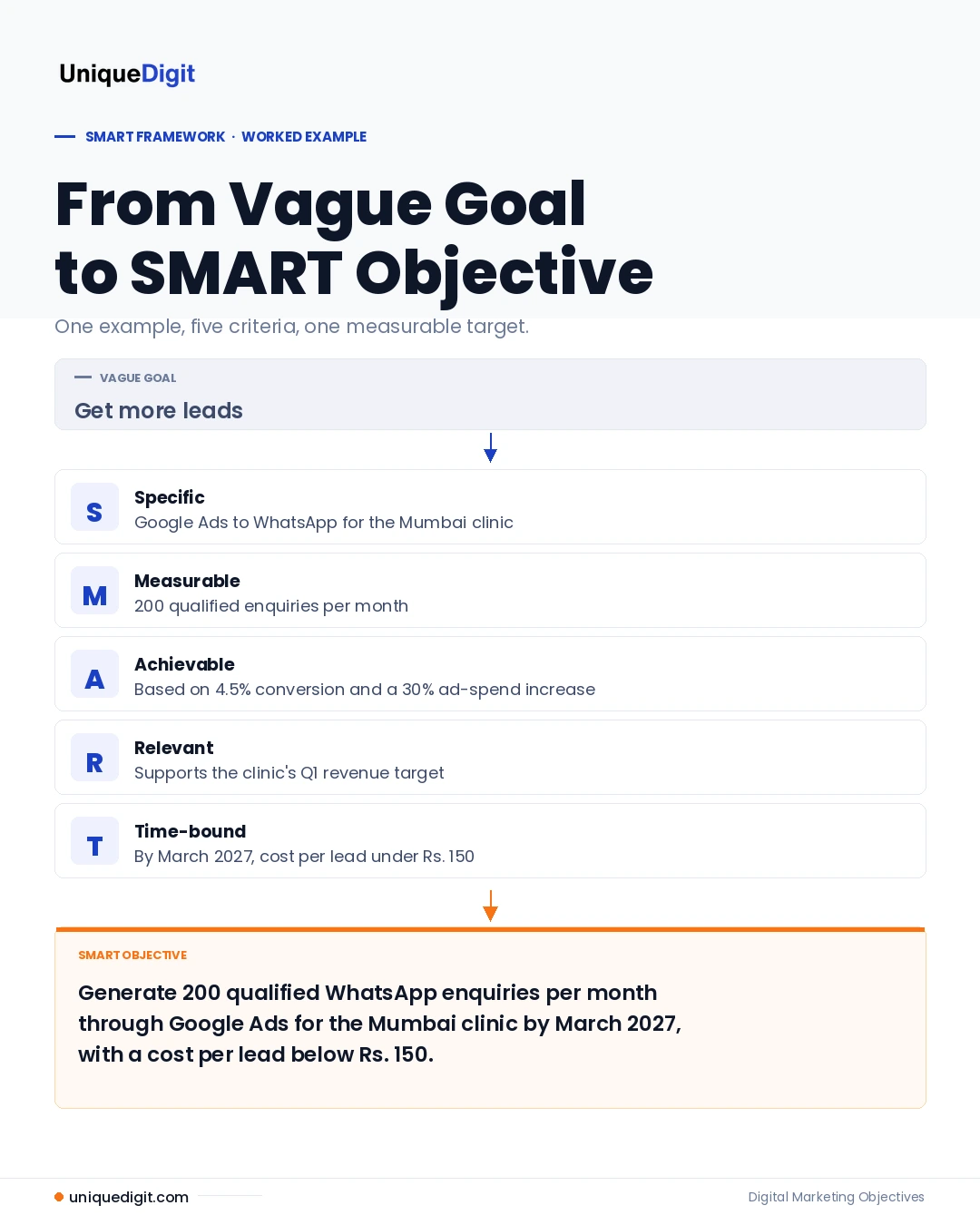
Setting objectives starts with knowing what you want to achieve and how you'll measure success. Instead of using broad goals like "get more leads," use the SMART framework to create clear, actionable objectives.
Here's how to turn a vague goal into a SMART objective:
- Vague goal: Get more leads
- Specific: Generate WhatsApp enquiries through Google Ads for the Mumbai clinic.
- Measurable: Achieve 200 qualified enquiries per month.
- Achievable: Based on the current 4.5% conversion rate and a planned 30% increase in ad spend.
- Relevant: Supports the clinic's Q1 revenue target.
- Time-bound: Reach this goal by March 2027 while keeping the cost per lead below ₹150.
SMART objective:
"Generate 200 qualified WhatsApp enquiries per month through Google Ads for the Mumbai clinic by March 2027, with a cost per lead below ₹150."
A well-defined objective gives your team a clear target, marketing channel, timeline, budget, and measurable outcome, making it much easier to track performance and improve results.
Here are three more SMART examples across different business types:
| Business | Vague Objective | SMART Objective |
|---|---|---|
| Coaching institute | Get more students | Increase organic website enquiries by 50% in 6 months through SEO targeting course-specific long-tail keywords |
| Restaurant | Be more visible online | Reach a 4.5 average Zomato rating with 500+ reviews by December 2026 through a post-dining feedback campaign |
| D2C skincare brand | Grow online sales | Achieve ₹12L monthly revenue from Meta Ads at 4x ROAS by Q1 2027 |
You cannot set a realistic target without a baseline. If you do not know your current conversion rate, average cost per lead, or monthly organic sessions, any number you pick is a guess. Pull 90 days of data from GA4 and Google Search Console before writing a single objective.
Set the objective. We'll handle the measurable execution.
Free personalised audit, delivered in 48 hours. Zero obligation.
What Is the Difference Between Strategy Objectives and Campaign Objectives?
Strategy objectives are long-term business goals, while campaign objectives are short-term goals designed to support them.
For example, a strategy objective might be increasing qualified leads by 30% over the next year. To achieve that, you could run a Google Ads campaign with the objective of generating 500 qualified leads in one month.
The key is alignment. Every campaign objective should contribute to a larger strategy objective. Otherwise, a campaign may hit its target but still have little impact on overall business growth.
| Strategy Objective | Campaign Objective |
|---|---|
| Timeframe | 6 to 12 months |
| Scope | Direction for the full marketing programme |
| Example | Grow organic traffic by 40% this year |
| Example | Increase qualified lead volume by 30% |
A strategy objective sets the direction. A campaign objective is one step toward that direction. Every campaign should trace back to a strategy objective. If it does not, it is probably a distraction.
The common mistake:
Measuring campaign-level metrics (clicks, impressions, CTR) and presenting them as strategy-level results. A campaign can hit every metric and still fail the strategy if it attracted the wrong audience or the wrong type of leads.
What Mistakes Should You Avoid When Setting Digital Marketing Objectives?
Avoid these common mistakes to ensure your digital marketing objectives drive real business results:
Focusing on vanity metrics
Metrics like followers, likes, and impressions may look impressive, but they don't always lead to sales or business growth. Prioritize objectives tied to measurable outcomes such as leads, conversions, or revenue.
Copying competitors' goals
Every business has a different starting point, budget, and audience. Set objectives based on your own performance and growth potential rather than someone else's targets.
Skipping performance tracking
Don't set objectives without the right analytics tools in place. Configure platforms like Google Analytics 4 (GA4) and conversion tracking before launching campaigns so you can accurately measure success.
Ignoring offline conversions
Many businesses generate leads through phone calls, walk-ins, or WhatsApp enquiries. Track these alongside website conversions to get a complete picture of your marketing performance.
Conclusion
Digital marketing objectives give your marketing strategy a clear direction and make it easier to measure success. Whether your focus is increasing website traffic, generating leads, improving conversions, or growing sales, setting the right objectives helps you achieve better results with every campaign.
Use SMART objectives, track the right KPIs, and review your performance regularly to improve your digital marketing efforts over time. If you need help creating a results-driven digital marketing strategy, Unique Digit can help you set the right digital marketing objectives and turn them into measurable business growth.