| Quick Answer: Facebook Ads let Indian businesses show highly targeted ads across Facebook and Instagram, paying only when someone clicks or acts. You can start with a daily budget of around Rs 200 to 500, choose an objective like leads or sales, target by location, interest, and behaviour, and send enquiries straight to WhatsApp. The keys to profit are a clear objective, a Facebook Pixel for tracking, sharp creative, and enough budget to let the algorithm learn before you judge the results. |
Why Do Facebook Ads Work So Well for Indian Businesses?
Facebook Ads work well for Indian businesses because they combine massive reach (over 400 million users), precise city-level targeting, a low starting cost of a few hundred rupees a day, and direct WhatsApp lead capture. Here is why each matters:
- Massive, engaged reach. With over 400 million Indian users across Facebook and Instagram, almost any audience you want is already on the platform.
- Precise targeting. You can reach people by city, pin code, age, interest, and behaviour, so a boutique in Pune shows ads only to nearby fashion-interested shoppers rather than the whole country.
- Low entry cost. You can start testing with a few hundred rupees a day, which suits small businesses and lets you learn before scaling.
- WhatsApp-friendly. Indian customers prefer to enquire on WhatsApp, and Facebook lets you send ad clicks straight into a WhatsApp chat, which shortens the path from ad to conversation.
How Much Do Facebook Ads Cost in India? (2026 Numbers)
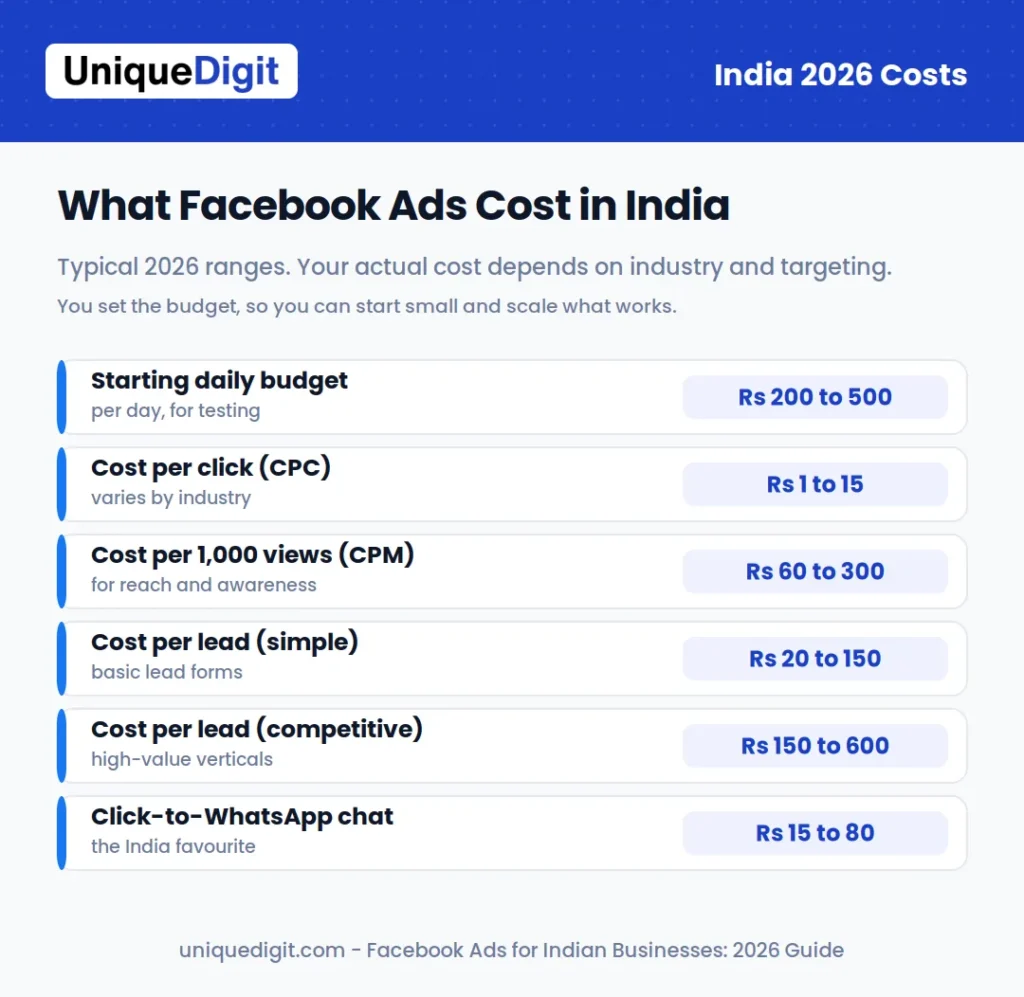 Facebook Ads in India cost roughly Rs 200 to 500 per day to start, with cost per click between Rs 1 and 15 and cost per lead from Rs 20 to 600 depending on your industry and targeting. Here are the realistic 2026 ranges:
| Item | Typical 2026 range in India |
|---|---|
| Starting daily budget (testing) | Rs 200 to 500 per day |
| Cost per click (CPC) | Rs 1 to 15, depending on industry and audience |
| Cost per 1,000 impressions (CPM) | Rs 60 to 300 |
| Cost per lead (CPL), simple lead forms | Rs 20 to 150 |
| Cost per lead (CPL), competitive verticals | Rs 150 to 600 |
| Cost per Click-to-WhatsApp conversation | Rs 15 to 80 |
| Agency management fee | 15 to 20 percent of ad spend, or a monthly minimum |
- The learning phase. Facebook’s algorithm typically needs around 50 conversions in 7 days to exit its learning phase and deliver efficiently. Starve a campaign of budget and it never learns, so give each campaign enough to gather that data.
- There is no residual value. Like all paid ads, the moment you stop paying, the traffic stops. That is fine for demand you need now, but it is why many businesses pair ads with organic channels. If you are weighing paid against organic, our guide on SEO vs Google Ads for Indian businesses breaks down the trade-off.
Daily Budget, CPC, CPL, and the Learning Phase
For a small business starting out, a sensible approach is:- Test at Rs 300 to 500 a day across one or two ad sets for at least 7 days before judging performance.
- Watch cost per lead, not cost per click. Cheap clicks that never convert are a false economy.
- Give it time. Avoid switching everything off after two days. The algorithm needs data to optimise, and early numbers rarely reflect the settled cost.
What Types of Facebook Ads Should Indian Businesses Use?
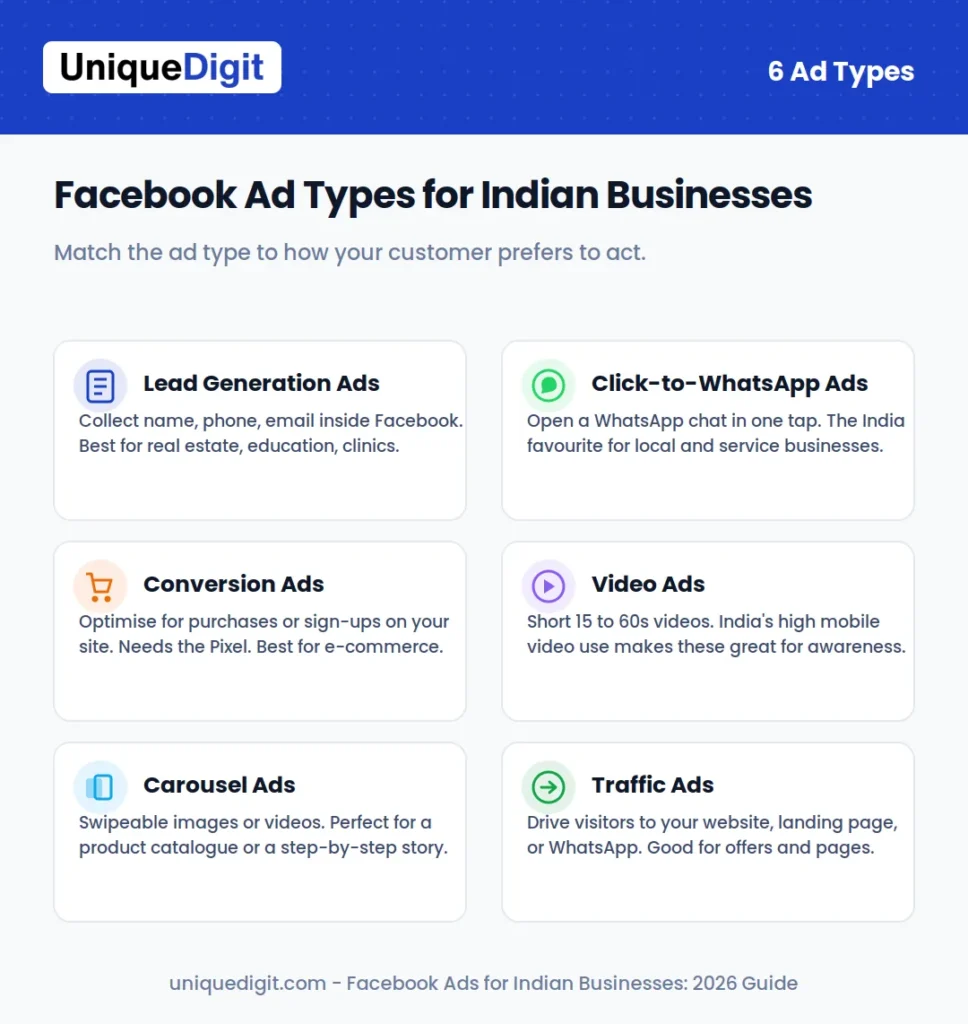 Indian businesses should use Lead Generation, Click-to-WhatsApp, Conversion, Video, Carousel, and Traffic ads, choosing the format that matches how their customers prefer to act. Here is what each does best:
- Lead Generation Ads. Collect a name, phone number, and email inside Facebook without the user leaving the app. Ideal for real estate, education, clinics, and events.
- Traffic Ads. Drive people to your website, landing page, or WhatsApp. Good for product pages and offers.
- Conversion Ads. Optimised to get a specific action (purchase, form fill) on your site. Needs the Facebook Pixel installed, and works best for e-commerce.
- Click-to-WhatsApp Ads. Send users straight into a WhatsApp chat with your business. Extremely popular in India for service businesses, coaches, and local shops.
- Video Ads. Short 15 to 60 second videos. India’s high mobile video consumption makes these strong for awareness.
- Carousel Ads. Show multiple images or videos in one swipeable ad, great for a product catalogue or a step-by-step story.
Click-to-WhatsApp Ads: The India Favourite
Click-to-WhatsApp ads are the best-performing format for most Indian businesses, because they open a WhatsApp chat in one tap and most Indian customers prefer messaging over forms or calls. These ads put a "Send Message" button on your ad that opens a WhatsApp chat pre-filled with a greeting, so the enquiry lands directly in a channel your team already checks all day. For local services, coaching centres, and small retailers, this often produces the cheapest and warmest leads on the platform.How Does Facebook Ads Targeting Work?
Facebook Ads targeting lets you define exactly who sees your ad by location, demographics, interests, and behaviour, plus three audience types (Core, Custom, and Lookalike). The main options for Indian businesses:- Location. Target specific cities, states, pin codes, or a radius around your shop.
- Demographics. Age, gender, education, and job title, based on your ideal customer.
- Interests. People who follow pages or show interest in topics related to your business.
- Behaviours. Online shoppers, recent travellers, device usage, and more.
Core, Custom, and Lookalike Audiences
- Core Audiences. Built from the location, demographic, interest, and behaviour filters above. This is where most beginners start.
- Custom Audiences. People who already know you, such as your website visitors (via the Pixel), your uploaded customer list, or people who engaged with your page. These warm audiences almost always convert better.
- Lookalike Audiences. Facebook finds new people who resemble your best existing customers. A 1 percent lookalike is the most similar, while a larger percentage gives you a bigger but looser pool. This is the main tool for scaling once you know who converts.
Which Industries Get the Best Results from Facebook Ads in India?
Local services, e-commerce, real estate, education, restaurants, and professional services get the strongest results from Facebook Ads, because their customers make quick, emotional, or visual buying decisions. Here is how it plays out by sector:- Local services (salons, clinics, gyms, coaching). Click-to-WhatsApp and lead ads shine here, since customers want a fast conversation. Tight local targeting keeps costs low.
- E-commerce and D2C brands. Video and carousel ads showcase products, while conversion campaigns with the Pixel and retargeting recover shoppers who did not buy the first time.
- Real estate and education. High-value leads justify richer creative and slightly higher cost per lead, and lead forms capture intent before a competitor does.
- Restaurants and hospitality. Visual, location-based ads for offers and new launches work well, especially around weekends and festivals.
- B2B and professional services. Slower to convert, so these do best with awareness and lead ads that build familiarity over time rather than expecting an instant sale.
How Do You Set Up a Facebook Ads Campaign? (Step by Step)
Set up a Facebook Ads campaign in six steps: install the Pixel, choose your objective, build your audience, set your budget, create your ad, and publish and monitor. Every campaign uses the same three-level structure, where the Campaign sets your goal, the Ad Set defines your audience, budget, and placements, and the Ad is the creative people see. Here is the practical setup:- Install the Facebook Pixel. This tracking code on your website lets Facebook optimise for conversions and build retargeting audiences. Do this before spending anything.
- Choose your campaign objective. Pick the goal that matches your business outcome, such as Leads, Traffic, or Sales. For most Indian businesses starting out, Leads and Traffic deliver the best early results.
- Build your target audience. Set your location, demographics, interests, and behaviours, or select a Custom or Lookalike Audience.
- Set your budget and schedule. Start with a daily budget you are comfortable testing, and consider Campaign Budget Optimisation to let Facebook spread spend efficiently across ad sets.
- Create your ad. Choose a format (image, video, carousel, or lead form), add your visual, write your copy, and pick a clear call to action like “Book Now” or “WhatsApp Us.”
- Publish and monitor. Review performance daily for the first two weeks, test different creatives and audiences, and scale the budget gradually once you find a winning combination.
How Do You Write and Design Ads That Convert in India?
Ads that convert in India use culturally relevant visuals, Hindi or regional text, a benefit-led first line, clear social proof, and a specific call to action. Apply these creative rules:
- Use relatable, culturally relevant visuals. Show real people using your product, in settings your audience recognises.
- Add Hindi or regional text or subtitles if you are targeting non-English speakers, since it lifts both trust and comprehension.
- Lead with the benefit. Put your strongest offer or benefit in the first line of copy, before anyone has to click “see more.”
- Add social proof. A line like “Trusted by 5,000+ customers in your city” builds instant credibility.
- Make the offer and CTA clear. “Book a free consultation” or “Get 30% off today” works far better than a vague “learn more.”
- Use urgency where it is genuine. “Limited slots this week” nudges action, as long as it is true.
How Do You Scale a Winning Facebook Ad?
Scale a winning Facebook ad by raising the budget about 20 percent every few days, expanding into fresh Lookalike Audiences, refreshing creative, and duplicating what works, so the algorithm keeps its efficiency. A sudden budget jump resets the learning phase and can spike costs, so scale carefully:- Scale gradually. Increase the budget by roughly 20 percent every few days so the algorithm adjusts without losing efficiency.
- Expand the audience. Build fresh Lookalike Audiences from your recent buyers or leads to find more people like them.
- Refresh the creative. As frequency climbs and the same people see your ad too often, new visuals and hooks keep performance from decaying.
- Duplicate what works. Copy a winning ad set into a new audience rather than overloading the original, which protects the results you already have.
Which Metrics Should You Track? (CTR, CPL, ROAS)
Track cost per lead, click-through rate, return on ad spend, and frequency, since these four metrics show whether your Facebook Ads actually make money rather than just generate clicks. Here is what each tells you:- Cost per lead (CPL) or cost per acquisition. The truest measure of what you pay for a real business outcome.
- Click-through rate (CTR). How compelling your ad is. A healthy CTR sits around 1 to 3 percent for many industries.
- Return on ad spend (ROAS). Revenue earned per rupee spent. For e-commerce, aim for a ratio that comfortably covers your margins.
- Frequency. How often the same person sees your ad. Keep it low (roughly 1 to 3) and refresh creative when it climbs, to avoid ad fatigue.
Should You Run Ads on Facebook and Instagram Together?
In most cases, yes. Facebook and Instagram are one Meta advertising system, so a single campaign can run across both, plus Messenger and the wider Audience Network. Rather than choosing one upfront, the simplest start is to let Facebook place your ads automatically across all of them and learn where your audience actually responds. If your data later shows most conversions come from Instagram, you can shift placements there. For visual, lifestyle, and younger audiences, Instagram often performs strongly, while Facebook tends to reach a broader and slightly older base. Running both gives the algorithm more room to find your cheapest results.What Are the Biggest Facebook Ads Mistakes Indian Businesses Make?
The biggest Facebook Ads mistakes Indian businesses make are targeting too broad on a small budget, ignoring retargeting, weak creative, not testing variations, stopping campaigns too early, and forgetting the Pixel. Each one quietly wastes money:- Targeting too broad on a small budget. A tiny budget spread across a huge audience never gathers enough data to optimise. Start focused.
- Ignoring retargeting. Warm audiences (past visitors and engagers) convert far better than cold ones, yet many businesses never set them up.
- Weak creative. Low-quality images and unclear messaging sink even a well-targeted ad.
- Not testing variations. Running a single ad gives the algorithm nothing to choose between. Always test two or three.
- Stopping campaigns too early. Killing a campaign before the learning phase finishes throws away the data it needed to improve.
- Forgetting the Facebook Pixel. Without it, you cannot track conversions properly or build retargeting audiences, which caps your results from day one.