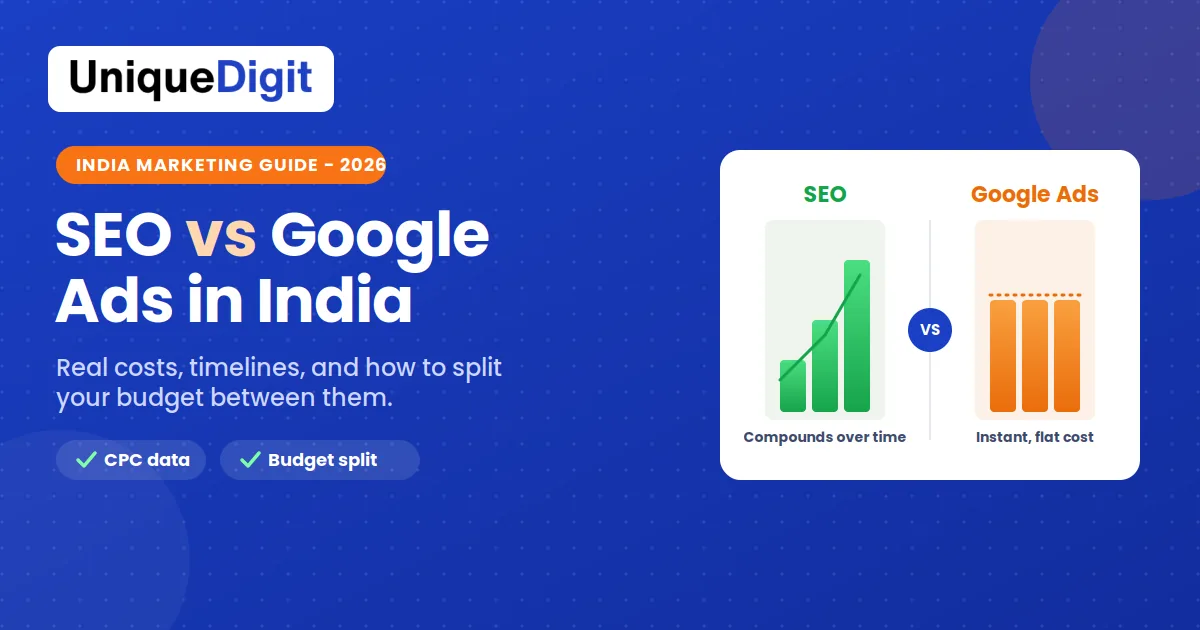
| Quick Answer: For most Indian businesses, the smartest choice is not SEO or Google Ads but a deliberate mix of both. Run Google Ads for immediate leads and cash flow, and build SEO in parallel for sustainable, lower-cost traffic that compounds over 6 to 12 months. A new business should start with a heavier ad weighting and shift toward SEO as rankings mature. The right split depends on your budget, timeline, and industry. |
Every growing business in India reaches this fork. Do you invest in SEO, or do you run Google Ads? It sounds like a simple either-or, and most of the advice online treats it that way, usually because the person writing it already sells one of the two.
The honest answer is less convenient and more useful. SEO and Google Ads solve two different problems. One builds visibility that compounds and keeps working after you stop paying. The other buys visibility instantly and stops the moment your budget runs out. This guide breaks down what each actually costs in India, how long each takes to work, and a practical framework for splitting your budget between them by business stage.
What Is the Real Difference Between SEO and Google Ads?
The two channels do related jobs in very different ways.
- SEO (search engine optimisation) earns you unpaid rankings. You invest in content, technical health, and authority so Google chooses to show your pages. You do not pay per click.
- Google Ads is pay-per-click. You bid on keywords, your ad shows at the top marked “Sponsored,” and you pay for every click. The placement is instant but lasts only as long as you keep paying.
The core trade-off is speed versus cost sustainability.
Google Ads is fast but rented. SEO is slow but owned. Once you see it that way, the question stops being which is better and becomes which fits your situation right now.
It also helps to see them as two different jobs:
- Google Ads captures demand. It puts you in front of people already searching for what you sell, at the moment they are ready to act.
- SEO captures and builds demand. It wins that same high-intent traffic organically, and also reaches the earlier research-stage searches that shape a buyer’s shortlist.
A business that only runs ads captures demand but never builds it. A business that only does SEO builds an asset but can miss urgent, ready-to-buy searches. That is the deeper reason the two work best together, and why treating it as a rivalry usually costs Indian businesses money.
Is SEO or Google Ads Better for Small Businesses in India?
For a small business, the honest answer leans on cash flow.
- Ads give you control from week one. If you need a predictable flow of enquiries to stay afloat, ads deliver that fast, which is why many small businesses start there.
- But ads alone are a trap. Your lead flow is only ever as healthy as your monthly budget, and Indian ad auctions have grown more expensive year on year. A business that never invests in SEO stays permanently dependent on paid spend, and its cost per lead tends to climb.
The businesses that break out of that cycle treat their first year of ads as a bridge, not a destination. They use the revenue and keyword data from ads to fund an SEO programme that steadily lowers their dependence on paid clicks. By the time competitors are still bidding up the same keywords, these businesses rank organically for them at no per-click cost. So the better question is not which channel to pick, but how quickly you can move from renting traffic to owning it.
How Much Does Each Cost in India? (Real 2026 Numbers)
Cost is usually the deciding factor for Indian small and mid-sized businesses, so it deserves real numbers rather than vague reassurance. The figures below are typical 2026 ranges. Treat them as a guide, since your category, city, and competition all move the number.
Google Ads: CPC and Monthly Spend by City Tier
With Google Ads you pay per click, and the cost per click (CPC) swings widely by industry and location.
| Item |
Typical 2026 range in India |
| CPC, Tier-1 cities (Mumbai, Delhi, Bangalore) |
Rs 30 to 200 for competitive keywords, Rs 5 to 30 for long-tail |
| CPC, Tier-2 cities (Indore, Jaipur, Lucknow) |
Rs 10 to 80 for competitive keywords, Rs 3 to 15 for long-tail |
| High-competition verticals (legal, finance, real estate) |
Rs 80 to 600 per click depending on city |
| Low-competition verticals (grocery, local services) |
Rs 8 to 15 per click |
| Monthly ad spend, small business |
Rs 10,000 to 50,000 |
| Monthly ad spend, medium business |
Rs 50,000 to 2,00,000 |
| Agency management fee |
15 to 20 percent of ad spend, or a monthly minimum |
The defining feature of these costs is that they are immediate and variable. You can start with a few hundred rupees a day and see clicks within hours. The catch is that there is no residual value. The spend that brought traffic last month does nothing for this month unless you spend again.
SEO: Monthly Retainers and What Drives the Price
SEO costs are harder to pin down because the work covers several activities and depends on where you are starting from.
| Item |
Typical 2026 range in India |
| SEO retainer, small business |
Rs 15,000 to 40,000 per month |
| SEO retainer, medium business |
Rs 40,000 to 1,00,000 per month |
| One-time technical SEO audit |
Rs 15,000 to 50,000 |
| High-quality content, per article |
Rs 2,000 to 8,000 |
| Quality backlink |
Rs 5,000 to 20,000 each |
SEO costs are more front-loaded. You invest heavily in the first three to six months on technical fixes, content, and early link building, then the ongoing spend shifts toward content and authority. Over time, as rankings strengthen, your cost per acquisition from SEO tends to fall, which is the opposite of Google Ads, where costs usually rise as competition grows. A common mistake worth flagging: businesses that try to cut this to a Rs 3,000 package almost always end up worse off, since low-effort SEO either does nothing or invites penalties. For a fuller breakdown, see our guide on SEO cost in India.
How Long Until Each One Works?
Timeline is often the real deciding factor, because a business that needs customers this month cannot wait two quarters.
Google Ads delivers the fastest results of any channel. A well-structured campaign can generate clicks within 24 to 48 hours of approval. That immediacy is invaluable for a new launch, a seasonal offer, or a market where organic competition is too strong to crack quickly.
SEO is a longer game, and the honest timeline looks like this:
- Months 1 to 3: technical fixes and initial content, with little visible ranking movement yet.
- Months 3 to 6: rankings begin on long-tail, lower-competition terms, and early organic traffic appears.
- Months 6 to 12: medium-competition keywords start ranking, and organic traffic grows steadily.
- Months 12 to 24: you compete for high-value, competitive terms, and traffic compounds.
For local terms in less competitive markets, such as a service plus a smaller city name, timelines can be shorter, often two to four months. For national, competitive keywords, patience is essential. The payoff is that once the foundation is built, it keeps working on weekends, holidays, and the days your team is off. Organic search does not clock out.
SEO vs Google Ads: Side-by-Side Comparison
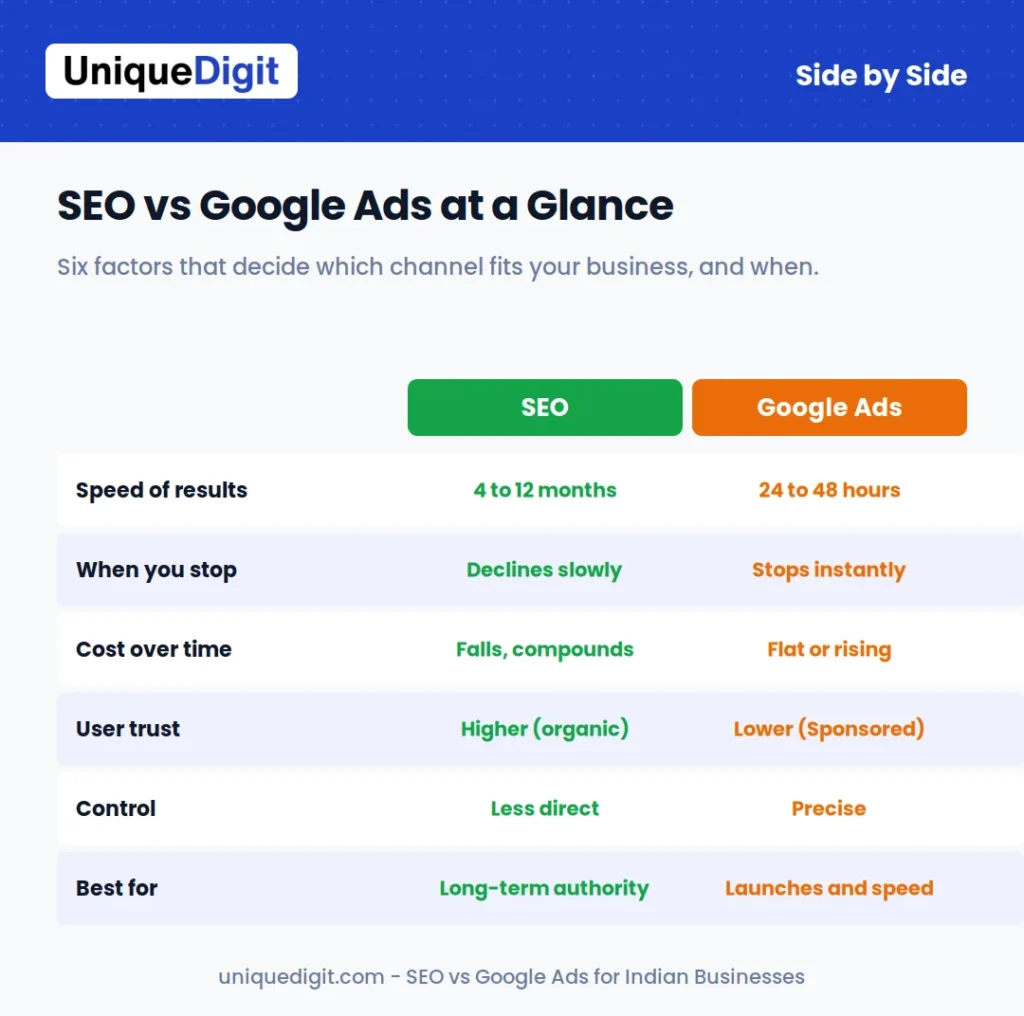
SEO vs Google Ads comparison at a glance: a table comparing the two channels across speed of results, what happens when you stop, cost over time, user trust, control, and what each is best for:
| Factor |
SEO |
Google Ads |
| When results show up |
4 to 12 months of consistent work |
Within 24 to 48 hours of launch |
| What happens when you stop |
Rankings decline slowly, not overnight |
Traffic stops immediately |
| Cost over time |
Cost per acquisition falls as rankings compound |
Cost per acquisition stays flat or rises |
| User trust |
Organic results carry more credibility |
The “Sponsored” label lowers trust for some users |
| Control |
Less direct control over timing and audience |
Precise control over targeting, timing, and spend |
| Best suited for |
Long-term authority and sustainable growth |
Launches, campaigns, testing, speed to market |
When Should You Choose Google Ads?
Despite SEO’s long-term edge, there are clear situations where Google Ads is the better first move:
- You need leads now. If your business needs enquiries this week, ads are the only option on that timeline. A new clinic or restaurant can run ads from day one while SEO builds in the background.
- Your customer is worth a lot. In real estate, healthcare, or B2B, ads pay off even at higher CPCs. A developer paying Rs 200 a click to win a lead that converts into a property sale has an obvious return.
- You want to test demand. Ads let you validate a new market or keyword set fast before committing to a full SEO strategy for it.
- You have a time-bound campaign. Festival sales, Diwali, year-end offers, and admission seasons all reward a channel you can switch on and off at will, which SEO cannot match.
If speed to market is the goal, our Google Ads management is built to make that spend efficient from the first day, with proper conversion tracking and landing pages that turn clicks into enquiries.
When Should You Choose SEO?
Equally, there are situations where SEO should be the priority investment:
- You are building for the long term. Every month you delay is compounding growth you forfeit, and starting early is itself an advantage as more competitors invest in search each year. Content marketing sits at the heart of it, since content published today keeps earning traffic for years.
- You sell on trust and expertise. For lawyers, chartered accountants, and consultants, organic content that demonstrates expertise builds credibility paid ads cannot. Content that ranks becomes a durable trust asset.
- You depend on local customers. Local SEO and a well-optimised Google Business Profile deliver exceptional value. In smaller cities, where competition is thinner, this can beat ads on cost within a few months. See how to rank higher on Google Business Profile in India.
- Your ongoing budget is limited. If you cannot commit to continuous ad spend, SEO suits you better, because the asset you build keeps generating value even in leaner months. Ads stop the moment the budget does.
Why Is Combining SEO and Google Ads the Best Strategy?
The businesses winning in 2026 rarely choose. They run both channels in a coordinated strategy where each one strengthens the other:
- Shared keyword data. Google Ads shows you fast which keywords actually convert, which you feed into your SEO priorities.
- Two spots on page one. Ranking organically and running an ad for the same term lifts your total clicks.
- Full-funnel coverage. Ads capture bottom-of-funnel, high-intent searches while SEO covers top-of-funnel, informational ones.
- More trust. Seeing your brand in both paid and organic results raises the odds someone clicks and converts.
A Budget-Split Framework by Business Stage
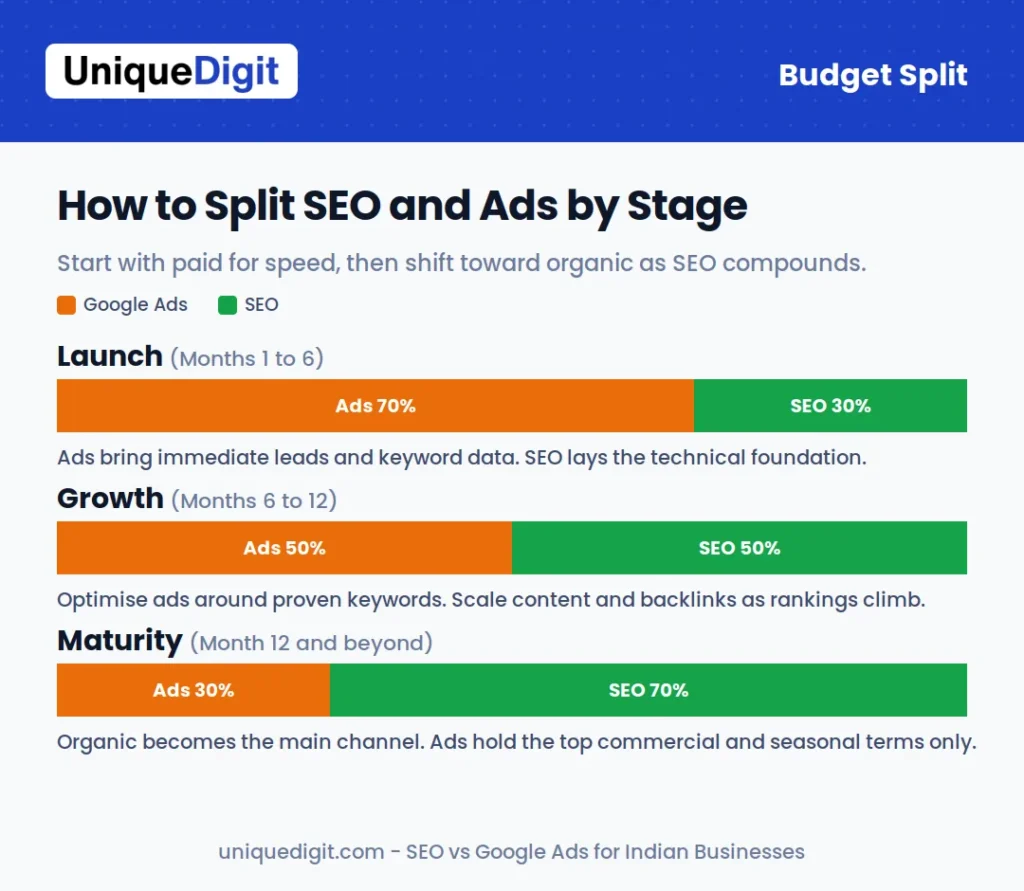
The most practical way to run both is to shift the balance as your SEO matures. Here is a framework that works for most Indian businesses.
| Stage |
Google Ads |
SEO |
Focus |
| Launch (months 1 to 6) |
70 percent |
30 percent |
Immediate leads and keyword data from ads; technical foundation and initial content for SEO |
| Growth (months 6 to 12) |
50 percent |
50 percent |
Optimise ads around proven keywords; scale content and links |
| Maturity (months 12 and beyond) |
30 percent |
70 percent |
Ads for top commercial and seasonal terms; organic becomes the primary channel |
The principle is simple: start with paid for speed and data, then gradually shift toward organic as SEO delivers compounding returns. This is a starting point, not a rulebook, so adjust it to your results and margins.
Which Split Fits Your Industry?
Different industries lean differently. These are sensible starting splits based on how each sector’s customers search and buy.
| Industry |
Suggested starting split |
Why |
| Healthcare (clinics, hospitals) |
60 percent Ads / 40 percent SEO, shifting to 30/70 later |
Health searches are often urgent, so ads win early, while SEO builds condition-specific authority |
| E-commerce and retail |
50 / 50 |
Product pages need SEO, while Shopping and search ads drive immediate sales |
| Professional services (CA, legal, consulting) |
40 percent Ads / 60 percent SEO |
These sectors run on trust and authority, which SEO builds better |
| Restaurants and hospitality |
70 percent Ads / 30 percent SEO (local) |
Searches are immediate and location-based, so ads and local SEO lead |
| Education and coaching |
50 / 50 |
Highly seasonal around admission cycles, so ads handle peaks while SEO builds a year-round base |
How Do You Measure ROI from SEO and Google Ads?
Neither channel is worth funding if you cannot see what it returns, and this is where many Indian businesses lose money quietly. The two are measured differently, because they pay back on different timelines.
For Google Ads, the numbers are immediate:
- Track cost per click, conversion rate, and above all cost per acquisition, which is what you actually pay to win one customer.
- Set up conversion tracking before you spend a single rupee. Ads without it are expensive guesswork.
- Judge each campaign on cost per acquisition, not on clicks or impressions, which flatter the report without paying the bills.
For SEO, the meaningful numbers move slowly, so measure monthly:
- Watch organic traffic growth, rankings for your priority terms, and leads attributed to organic search.
- Read it as a trend line over quarters, not a daily snapshot, because SEO compounds.
- Remember the lifetime value: a page that brings ten leads a month for two years is worth far more than its one-time cost.
Free tools like Google Analytics and Google Search Console cover most of what a small business needs. The single most useful habit is to compare cost per lead from each channel every month and move budget toward the better performer, while giving SEO the runway it needs before you judge it.
What Does a Combined SEO and Google Ads Strategy Look Like in Practice?
Seeing it play out makes it concrete. Take a mid-sized clinic in a Tier-2 Indian city that needs patients now but wants to stop depending on ad spend forever.
- Quarter one: most of the budget goes into Google Ads on high-intent local searches like “physiotherapy near me.” Enquiries arrive within days, and the ads reveal exactly which keywords convert into booked patients. A smaller share funds the SEO foundation: technical fixes, a complete Google Business Profile, and useful pages on the conditions the clinic treats.
- Mid-year: those SEO pages start ranking for long-tail searches, and organic enquiries arrive at no per-click cost. The clinic uses its ad conversion data to decide which content to build next, so SEO targets proven money keywords. Ad spend narrows to the most competitive terms.
- Year-end: organic delivers a meaningful share of enquiries at near-zero marginal cost. The clinic trims ads on terms it now ranks for and redirects that money into more content and links.
The result: total lead volume is higher than when the clinic ran ads alone, and the average cost per patient has fallen. That is the compounding logic of a combined strategy. Paid buys the early momentum, organic builds the durable asset, and each makes the other smarter.
Which Is Better: SEO, Google Ads, or Social Media?
SEO and Google Ads are the heavyweights of search, but they are not the only channels competing for an Indian marketing budget. The simplest way to place social media alongside them is by intent.
- Search captures existing intent. When someone types “best CA in Jaipur,” they already want the service, and SEO or Google Ads puts you in front of that ready buyer.
- Social media builds discovery. People on Instagram or Facebook are not usually searching for your service in that moment, so a strong social media presence is better at building awareness and staying front of mind. It warms up an audience that later searches for you by name, which lifts your branded search and SEO.
For most Indian businesses, the sensible sequence is to win search first, where ready-to-buy demand lives, then layer social on top to feed future search. These channels are not rivals for the same rupee. They occupy different stages of the same journey, and the businesses that grow fastest connect them rather than choosing between them.
How Does AI Search Change the SEO vs Google Ads Question in 2026?
There is a newer layer to this decision that most older comparisons miss. Google’s AI Overviews now appear for a large share of searches, and answer engines like ChatGPT, Gemini, and Perplexity increasingly sit between your customer and your website.
This raises the stakes on SEO rather than lowering them:
- AI answers draw from the same source. AI Overviews and answer engines pull from the same index and trust signals that traditional rankings rely on. A page invisible to classic search is invisible to AI answers too.
- Ads have little presence in AI answers. That makes organic authority the surer route to being cited.
The practical takeaway is that strong SEO now does double duty, earning both classic rankings and AI-answer citations. If AI visibility matters to you, our guide on how to get featured in Google AI Overviews covers the specifics.
What Are the Biggest SEO and Google Ads Mistakes Indian Businesses Make?
The same errors show up again and again across industries, cities, and budgets.
- Cycling between channels without committing. Running ads for three months, switching to SEO, then quitting at month four because results are not dramatic yet. That pattern burns budget and builds nothing durable. Both channels need time and consistency.
- Ignoring the website underneath. It does not matter how sharp your ads or rankings are if the site is slow, confusing, or unconvincing. A fast, clear, mobile-friendly site lifts your ad Quality Score, your rankings, and your conversion rate at the same time.
- Chasing price over capability. There is no shortage of agencies selling Rs 3,000 packages. Marketing done badly costs far more in the long run than doing it properly from the start.
- Running ads without conversion tracking. Clicks with no conversion tracking are expensive vanity metrics. Without tracking cost per acquisition and a landing page built to convert, ad spend leaks. For more, see the common SEO and marketing mistakes that kill results.
- Expecting SEO to work at Google Ads speed. This is the mistake that quietly wastes the most, because it causes businesses to abandon SEO right before it pays off. Organic growth accelerates sharply only after the six-month mark, once your domain earns enough trust. Businesses that quit at month three have spent the money without collecting the return. If you commit to SEO, commit to the timeline it actually runs on.
- Neglecting on-page and technical fundamentals. Pouring budget into content or ads while the site itself is slow, poorly structured, or hard for Google to crawl is like filling a leaking bucket. The technical foundation determines whether any of your other effort converts. Understanding the split between on-page and off-page SEO helps you spend on the right fixes in the right order.
- Treating local search as an afterthought. For any business with a physical location or a local service area, an incomplete Google Business Profile leaves easy visibility on the table. Local rankings and the map pack are often the highest-ROI search real estate a small Indian business can win, and they cost nothing to claim.
How Do You Decide Between SEO and Google Ads for Your Business?
If you strip away the noise, the decision comes down to a handful of honest questions about your own situation. Work through these before you spend anything.
- How soon do you need results? If you need enquiries within weeks, start with Google Ads. If you can wait a few months for a bigger long-term payoff, weight toward SEO.
- What is your monthly budget? Below roughly Rs 15,000 a month in total, pick one channel and do it well. Above Rs 50,000, you can run both effectively.
- How competitive is your industry? Highly competitive categories usually need both channels working together. Less competitive local markets can often grow on SEO alone.
- What is a customer worth to you? High customer-lifetime-value businesses can absorb higher ad costs and should run both. Lower-value businesses lean on SEO’s cheaper cost per acquisition.
- Do you already have a website with some authority? An established site speeds up SEO results. A brand-new site needs ads to cover the gap while SEO matures.
There is no universal winner hidden in these answers, only the right mix for your stage, budget, and goals. The businesses that struggle most are not the ones that chose the “wrong” channel. They are the ones that chose only one channel and expected it to do everything.
Conclusion
SEO versus Google Ads was never really an either-or question. Google Ads buys you speed and immediate leads, while SEO builds an owned asset that compounds and lowers your cost per lead over time. The businesses that struggle are usually the ones that picked a single channel and expected it to do everything. The ones that win start with paid for momentum, build organic for durability, and shift the balance as their rankings mature.
If you would rather have this handled by a team that runs both under one strategy, that is exactly what we do at Unique Digit. From SEO and Google Ads to local SEO built for both Google and AI-driven search, we help you spend where it actually returns. Start with a free website audit and we will map the right split for your business.